

Launch an Independent Rollup on Ethereum Sepolia
Independent, operator-owned rollup
This runbook launches a fresh Zeko L2 that settles on Ethereum Sepolia. Every key, contract, genesis ledger and configuration file is created by you and belongs to your rollup. It does not connect to, and is not operated by, the Zeko-run network. For the Mina-backed stack, use Legacy: Launch a Mina-backed Rollup.
The rollup posts settlement proofs through a gateway that speaks the Mina-compatible GraphQL the sequencer expects and submits SP1 proofs to the ZekoSettlement and EthereumZekoBridge contracts you deploy.
You run: Sequencer, Sequencer signer, Prover, one DA node (quorum 1) with its DA signer, the Gateway (Ethereum settlement, bridge and Mina-compatible L1 façade), Archive, Archive relay, Archive node API, Actions API, Actions indexer, Bridge UI, Explorer UI, PostgreSQL and RabbitMQ. The service configuration table lists the image of each.
The whole stack is one docker compose file; one-time preparation steps live in the same file under the bootstrap profile. Skip to the Bootstrap process if you only want the commands.
docker compose down -v erases your rollup
The named volumes hold the DA database, the sequencer ledger, PostgreSQL and the prover state. Removing them deletes state that cannot be regenerated. Never run docker compose down -v without a backup; see Stopping the stack.
Prerequisites
Matching generations. The gateway image and the sequencer image must come from matching revisions. The
sepolia-pocimages do; if you rebuild one side, rebuild the other from the same generation.
System requirements
- Linux
x86_64host (the published images arex86_64-linuxonly) - RAM: 64 GB minimum for the whole stack on one host. The prover holds about 23 GB resident after compiling the circuits; the genesis export (step 5) and
build-guests(step 6) each need 16 GB+ on top while the prover runs. The prover compiles the Zeko circuits at every start: minutes on a fast host, hours on a small one; the health check allows 8 h. Running the prover on a separate host is possible (it needs only RabbitMQ and the signer) but is an advanced configuration not covered here; this guide is single-host. - Disk for PostgreSQL (four databases), the DA database and the sequencer ledger.
- A host that stays awake. Suspend freezes every container; nothing is lost, but settlement stops until the host wakes and the gateway has re-indexed the missed blocks (see Troubleshooting).
Installed software
Dockerwith Docker Compose v2.24 or newer (docker compose; theenv_filerequired: falseattribute used below needs v2.24+)jq,sha256sum,curl,git,setfacl(theaclpackage) on the host for the bootstrap recipes belowopensslfor the random tokens in step 1. If it is absent (for example on NixOS), run it ad hoc withnix shell nixpkgs#openssl, or replace eachopenssl rand -hex 32withhead -c 48 /dev/urandom | base64 | tr -dc 'A-Za-z0-9' | head -c 32
No Foundry, Rust, OCaml or Node toolchain is needed on the host: forge and cast ship in the zeko-bootstrap image and every other binary ships in its service image.
Tested release
The sepolia-poc tag is mutable; this guide expects the image set below. Verify your pulls against it (docker images --digests 'zekolabs/*:sepolia-poc') and keep the table with your deployment record. Source revisions: zeko-labs/zeko b9ee412c3f (sequencer, DA, archive, archive-node-api, bootstrap roles), zeko-labs/ethereum-settlement 15c93d0 (gateway, bridge UI, explorer UI, bootstrap tooling), zeko-labs/zeko-ui d666735e (Actions API and indexer). Put the zeko revision into ZEKO_SOURCE_REVISION.
| Image | Digest |
|---|---|
zekolabs/zeko-actions-api:sepolia-poc | sha256:6c002cb9ad345db2ba71c73f8b57bccd5854660e42eb406deb1501eebb77b26b |
zekolabs/zeko-actions-indexer:sepolia-poc | sha256:f4e05eace346ff766805302403c8189c6b9b13db4bcb5f5f05cc02f4c3aca161 |
zekolabs/zeko-archive-node-api:sepolia-poc | sha256:3ec68e5c69fcd28c4636c10c7a4c51dd480df5093e12858e3ddda1ed90bd2734 |
zekolabs/zeko-archive-relay:sepolia-poc | sha256:eef12467345b361634d8e84bbc59e66b82a7ac3c6bcd6eea3c242cb9d4aa99f5 |
zekolabs/zeko-archive:sepolia-poc | sha256:42dcf98b2e6601381e669df334131a8d108acbc1753bc82b48ae4273b1cdadc5 |
zekolabs/zeko-bootstrap:sepolia-poc | sha256:8c88809da19c3dbb7ea09c05ef02dbd375c1f6dcddea6d7f122c9f3b4af7f0e8 |
zekolabs/zeko-bridge-ui:sepolia-poc | sha256:1475b70afe67da6a07c7d549aa11dfde03282e56203227e1b6a1685c5ff468ed |
zekolabs/zeko-da:sepolia-poc | sha256:d09c969e0e5259dae26ef715eb7537a25e2d705b9ff6d39a61c7dab12f36d539 |
zekolabs/zeko-explorer-ui:sepolia-poc | sha256:0b240bb34af42d122c117e0e8d853996d9a4d2e24700a7dfcc574b454e4fdbed |
zekolabs/zeko-gateway:sepolia-poc | sha256:f1125f3e5c815999fc18aa7e78526b1f1c39bb743bc2036befe5623ee4c7b85c |
zekolabs/zeko:sepolia-poc | sha256:fc309de2be12416f3a7bf42785658d64c9ab21f13b595acd89265985d5582c67 |
Supporting images: postgres:16 and rabbitmq:4 (major-pinned official images). To remove the manual match entirely, replace each image: in the Compose with its docker.io/zekolabs/<name>@sha256:… digest from this table.
Operator-provided external inputs
| Input | Why | Notes |
|---|---|---|
| Sepolia JSON-RPC URL | Gateway RPC_URL; deploy --rpc-url | Your own provider. Never share one key between unrelated services. |
| Funded Sepolia admin/deployer wallet | Deploys the contracts once | You fund it yourself; there is no faucet in this stack. |
| Funded Sepolia gateway prover wallet | Submits settlement and bridge transactions | Receives PROVER_ROLE. Must differ from admin. |
| Upgrader address | UPGRADER_ROLE on both proxies | Address only; keep the key offline. |
| Browser wallet for the lifecycle test | Deposits, L2 payments, withdrawals | MetaMask Flask (Development) from the Chrome Web Store with a fresh seed; it installs the Zeko Snap and serves both the Sepolia and the Zeko side. Alternative for the Zeko side: Auro. See Lifecycle examples. |
| Proving mode | See Proving | This guide deploys the mock verifier: no SP1 proof is verified on L1. |
Proving
This demo deploys with the mock SP1 verifier: the contracts are deployed with LOCAL_MOCK_VERIFIER=true and the gateway runs with API_LOCAL_MOCK_SUBMIT=true and API_UNSAFE_ALLOW_MOCK_ON_SEPOLIA=true. The gateway executes the SP1 guests locally for their public values and submits them with empty proof bytes, which the mock verifier accepts. This shows the whole bridge and settlement loop without a proving service, but nothing is verified on Ethereum: use it only for disposable test deployments. The Zeko-side prover (zeko-prover) is not mock; it compiles the real circuits and proves every commit locally.
Real proving is out of scope of this demo. A deployment whose settlements are verified on Ethereum differs only in these knobs:
- Choose the commit validity window before the genesis export (step 5):
ZEKO_ETHEREUM_COMMIT_VALIDITY_PERIODon the exporter and--commit-validity-periodon the sequencer, same value; the settlement tooling default is2400slots (8 hours), and the window cannot be changed after the export. - In
config/deploy.env(step 7) writeSP1_VERIFIER_ADDRESS=0xb69f2584CBcFf99a58C4e7002E8b89Af54a6f4e2(the official SP1 v6.1.0 Groth16 verifier on Sepolia) instead ofLOCAL_MOCK_VERIFIER=true; admin, gateway prover and upgrader must then be three distinct addresses. - Start the gateway with
API_EXECUTE_ONLY=true,API_LOCAL_MOCK_SUBMIT=falseandAPI_UNSAFE_ALLOW_MOCK_ON_SEPOLIA=false, and confirm one job reachesexecutedinGET /v1/proofs. - Then fund a Succinct Prover Network requester, write its key into
secrets/sp1_network_keyin place (so the ACL survives), setAPI_EXECUTE_ONLY=false,API_REQUIRE_PROOF_APPROVAL=true,PROVER_GAS_LIMITandPROVER_MAX_PRICE_PER_PGU, rundocker compose up -d gateway, and approve each job throughGET /v1/proofs/:id/quoteandPOST /v1/proofs/:id/approve.
Overview
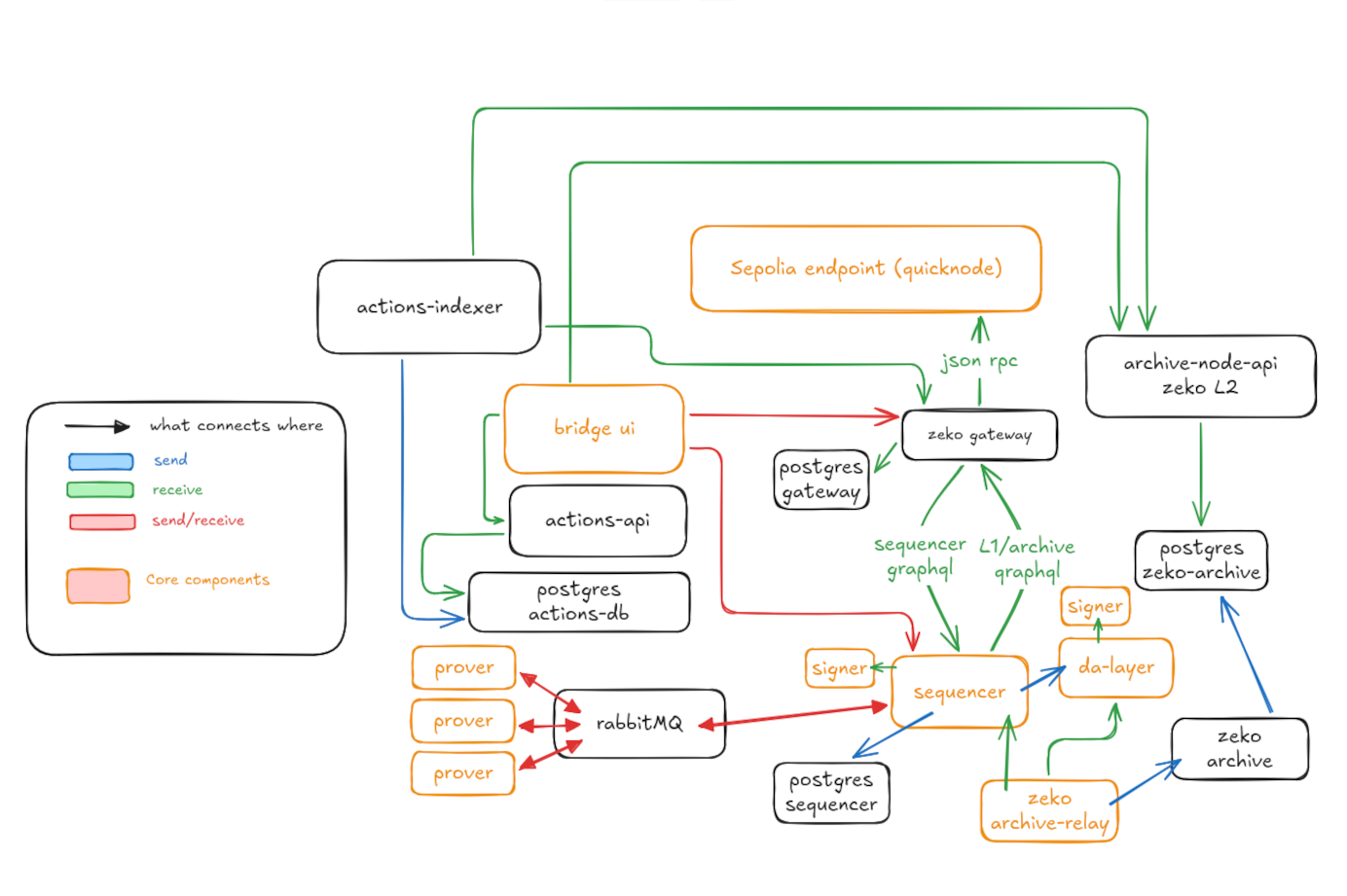
Legend: blue arrows are writes, green arrows are reads, red arrows carry traffic both ways; orange boxes are the Zeko core components, black boxes the supporting services. The sequencer reads outer-account state from the gateway, signs through its signer, stores diffs in DA and PostgreSQL, and hands proving work to the prover through RabbitMQ. The gateway is the only service that talks to Sepolia. The archive relay copies DA diffs into the archive database that archive-node-api serves to the Actions indexer; the bridge UI reaches the gateway, the sequencer and the Actions API from the browser.
The steps:
- Create the Ethereum admin wallet and predict the deterministic contract addresses.
- Create the Zeko sequencer and DA keys, signer TLS material and the circuit/deploy configuration bound to the predicted bridge address.
- Start the long-lived Zeko services and run the exporter: one real first proof that yields the genesis ledger, the deployment manifest and the public settlement VK.
- Compile the SP1 guests against that VK, compute the program vkeys and deploy the contracts (dry run, then
--broadcast). - Start the gateway with the artifacts mounted, then the sequencer, archive stack, Actions services and UIs.
Nothing here builds images. Every image reference is docker.io/zekolabs/<name>:sepolia-poc; docker compose up pulls them from Docker Hub. If your host has no access to Docker Hub, load the eleven images under that tag yourself before you start.
Wallets and keys
| Identity | Format | Created by | Used by |
|---|---|---|---|
admin / deployer | Ethereum 0x… | cast wallet new (bootstrap image) | predict-address, deploy; owns the PoC factory |
| gateway prover | Ethereum 0x… | cast wallet new | gateway ETHEREUM_PRIVATE_KEY; GATEWAY_PROVER_ADDRESS at deploy |
| upgrader | Ethereum address | cast wallet new in step 1 | UPGRADER_ADDRESS at deploy (key stays offline; nothing on the host uses it) |
| Succinct requester | Ethereum 0x… | your choice | gateway NETWORK_PRIVATE_KEY (network proving only) |
sequencer | Zeko Base58 private key (even public key) | zeko-cli generate-even-key | sequencer signer MINA_PRIVATE_KEY; its public key is the fee payer |
da1 | Zeko Base58 private key | zeko-cli generate-even-key | DA signer MINA_PRIVATE_KEY; public key is --da-keys |
| signer auth token | random string | you (openssl rand -hex 32) | ZEKO_SIGNER_AUTH_TOKEN shared by signers and their clients |
| signer TLS cert/key | X.509 | zeko-bootstrap-signer-tls role | signers serve it; clients verify ZEKO_SIGNER_TLS_HOSTNAME |
| gateway API key | random string | you | gateway PROOF_API_KEY; sequencer ZEKO_ETHEREUM_GATEWAY_TOKEN |
| indexer auth token | random string | you | Actions indexer AUTH_TOKEN (control endpoints) |
| circuit/deploy config | JSON with fresh private keys | zeko-bootstrap-generate-config role | prover, sequencer, exporter |
Note: some variable names keep Mina wording (
MINA_PRIVATE_KEY,MINA_SIGNING_NETWORK_ID,VIRTUAL_MINA_*). The signing network id of this stack istestnet; the bridge UI refuses anything else.
Project structure
Everything lives in one persistent workspace outside any source checkout:
zeko-sepolia/
├── docker-compose.yaml
├── .env                      # 0600; passwords, image tag, public addresses
├── secrets/                  # 0700; one file per secret (Compose file secrets)
├── config/
│   ├── circuits-config.json  # generate-config output (private)
│   ├── deploy-config.json    # generate-config output (private)
│   ├── deploy.env            # DeployPoc.s.sol inputs (public values)
│   ├── virtual-mina-accounts.json
│   ├── bridge-runtime-config.json
│   ├── explorer-runtime-config.json
│   └── postgres-init/        # 0755; first-start database initialization (public SQL only)
├── tls/                      # ca/signer.crt (public), private/signer.key
├── out/export/               # exporter output: first proof, genesis, manifest, VK
├── artifacts/                # settlement-vk.serde.json + guest ELFs (gateway mount)
└── state/                    # bind-mounted writable state of the one-shot roles
Volumes and files
| Volume / directory | Files | Purpose |
|---|---|---|
secrets/ | sequencer_key, da1_key, signer_auth_token, deployer_key, gateway_api_key, gateway_ethereum_key, sp1_network_key, indexer_auth_token | Secret files mounted under /run/secrets |
config/ | see above | Private Zeko configuration, public deploy inputs, UI runtime configs |
tls/ | ca/signer.crt, private/signer.key | Signer TLS material from zeko-bootstrap-signer-tls |
out/export/ | deployment-manifest.json, genesis-ledger.json, settlement.json, settlement-vk.serde.json, vk.serde.json, proof.serde.json, … | Export of the first proof; contract genesis comes from it |
artifacts/ | settlement-vk.serde.json, settlement-program, bridge-program, SHA256SUMS, provenance.json | Read by the gateway at startup (ZEKO_ARTIFACTS_DIR) |
state/ | per one-shot service | Forge workspace and broadcast/ records, cargo target, exporter sequencer state |
postgres_data | PostgreSQL: sequencer, gateway, archive, actions databases | |
rabbitmq_data | RabbitMQ | |
da1_data | DA node database, including the genesis diff posted by the exporter | |
sequencer_data | Sequencer ledger and checkpoints | |
prover_state | Prover home | |
gateway_state | Gateway home (/var/lib/zeko-proof-api, owned by uid 65532 in the image) | |
archive_relay_data | Archive relay database |
Note: Files you must read or hand between steps (secrets, config, export, artifacts) are bind mounts in the workspace. State that only services write lives in named volumes. Back up both.
Ports
| Service | Container port | Published (on 127.0.0.1) | Description |
|---|---|---|---|
gateway | 8080 | http://localhost:8080 | GraphQL, archive GraphQL, REST, health (browser-facing) |
sequencer | 1923 | http://localhost:1923 | Sequencer GraphQL (browser-facing, wallets) |
actions-api | 9100 | http://localhost:9100 | Actions GraphQL (browser-facing) |
actions-indexer | 3600 | http://localhost:3600 | /health, bearer-protected control endpoints |
bridge-ui | 4174 | http://localhost:4174 | Bridge web app |
explorer-ui | 4175 | http://localhost:4175 | Explorer web app |
archive-node-api | 8080 | – | L2 archive GraphQL (internal) |
archive | 3086 | – | Archive server port used by the relay |
sequencer-signer / da1-signer | 8600 / 8601 | – | Signer services (TLS) |
da1 | 8555 / 8558 | – | DA RPC / health |
postgres / rabbitmq | 5432 / 5672 | – | Internal only |
Every published port is bound to 127.0.0.1; use the services in the browser as http://localhost:<port>, and put the same URLs into the UI runtime configs and API_CORS_ALLOWED_ORIGINS. The sequencer GraphQL endpoint stays open to any origin (ZEKO_GRAPHQL_CORS_ALLOWED_ORIGINS unset) because wallet Snaps query it from MetaMask's own origin. Compose service names resolve only between containers.
Reaching a remote host
When the Docker host is a remote machine, keep the same configuration and bring the ports to your laptop with an SSH tunnel; the browser then sees the localhost origins the runtime configs name:
ssh -N -L 4174:127.0.0.1:4174 -L 4175:127.0.0.1:4175 -L 8080:127.0.0.1:8080 \
       -L 1923:127.0.0.1:1923 -L 9100:127.0.0.1:9100 -L 3600:127.0.0.1:3600 <user>@<host>
For public access (not covered here), put a TLS reverse proxy in front of ports 4174, 4175, 8080, 1923 and 9100, use the public names in both runtime configs and in API_CORS_ALLOWED_ORIGINS, and keep 3600 private.
Bootstrap process
Create the workspace
umask 077
mkdir -p ~/zeko-sepolia && cd ~/zeko-sepolia
mkdir -p secrets config/postgres-init/actions config/postgres-init/archive tls/ca tls/private \
  out/export artifacts state/zeko-tools state/exporter state/l1 state/bootstrap
chmod 0755 tls/ca artifacts config/postgres-init config/postgres-init/actions config/postgres-init/archive
umask 077 keeps everything you create private; the postgres-init directories are read by the container's postgres user and stay 0755 / 0644.
Download the versioned bundle that matches the Tested release, or copy the blocks from this page: docker-compose.yaml and the three postgres-init files (01-databases.sh, archive/create_schema.sql, actions/schema.sql) are byte-identical to the blocks embedded below. Copy docker-compose.yaml into the workspace verbatim and create .env (mode 0600). Values carry no quotes and no inline comments, so that the host shell can read them back verbatim:
cat > .env <<EOF
# Absolute path of this directory; your uid/gid (output of id -u and id -g) for the one-shot roles
ZEKO_WORKSPACE=/home/<you>/zeko-sepolia
ZEKO_UID=$(id -u)
ZEKO_GID=$(id -g)
# zeko commit the images were built from (the exporter records it in the manifest)
ZEKO_SOURCE_REVISION=<zeko commit>
MINA_SIGNING_NETWORK_ID=testnet
ZEKO_POSTGRES_PASSWORD=<random A-Za-z0-9>
ZEKO_RABBITMQ_USER=zeko
ZEKO_RABBITMQ_PASSWORD=<random>
SEPOLIA_RPC_URL=<your provider URL>
PROOF_SYSTEM=groth16
# Mock-verifier demo: the gateway submits empty proof bytes. Real proving: EXECUTE_ONLY=true first, then network credentials.
API_EXECUTE_ONLY=false
API_LOCAL_MOCK_SUBMIT=true
API_UNSAFE_ALLOW_MOCK_ON_SEPOLIA=true
API_REQUIRE_PROOF_APPROVAL=false
PROVER_GAS_LIMIT=
PROVER_MAX_PRICE_PER_PGU=
API_CORS_ALLOWED_ORIGINS=http://localhost:4174,http://localhost:4175
# Filled in by later steps (1: admin; 2: contracts; 3: DA key; 7: block and fork slot; 8: VIRTUAL_MINA_*)
ADMIN_ADDRESS=
SETTLEMENT_CONTRACT_ADDRESS=
BRIDGE_CONTRACT_ADDRESS=
DA1_PUBLIC_KEY=
ETHEREUM_INDEXER_START_BLOCK=
VIRTUAL_MINA_FORK_SLOT=
VIRTUAL_MINA_OUTER_PUBLIC_KEY=
VIRTUAL_MINA_INNER_PUBLIC_KEY=
VIRTUAL_MINA_FEE_PAYER_PUBLIC_KEY=
VIRTUAL_MINA_GENESIS_TIMESTAMP=
EOF
chmod 0600 .env
Compose does not export .env into your shell. The host commands below read single values with this helper; define it in every new shell you open in the workspace:
envget() { grep -m1 "^$1=" .env | cut -d= -f2-; }Every bootstrap command works with the empty later-phase values; each service refuses to start while a value it needs is still empty.
Click to expand docker-compose.yaml
name: zeko-sepolia

services:
  postgres:
    image: postgres:16
    restart: unless-stopped
    environment:
      POSTGRES_USER: zeko
      POSTGRES_PASSWORD: ${ZEKO_POSTGRES_PASSWORD:?}
      POSTGRES_DB: sequencer
    volumes:
      - postgres_data:/var/lib/postgresql/data
      - ./config/postgres-init:/docker-entrypoint-initdb.d:ro
    healthcheck:
      test: ["CMD-SHELL", "pg_isready -U zeko -d sequencer"]
      interval: 5s
      retries: 60

  rabbitmq:
    image: rabbitmq:4
    restart: unless-stopped
    environment:
      RABBITMQ_DEFAULT_USER: ${ZEKO_RABBITMQ_USER:?}
      RABBITMQ_DEFAULT_PASS: ${ZEKO_RABBITMQ_PASSWORD:?}
    volumes:
      - rabbitmq_data:/var/lib/rabbitmq
    healthcheck:
      test: ["CMD", "rabbitmq-diagnostics", "-q", "ping"]
      interval: 10s
      retries: 30
      start_period: 30s

  # ---------------------------------------------------------------- signers / DA
  sequencer-signer:
    image: docker.io/zekolabs/zeko:sepolia-poc
    tmpfs:
      - /tmp:mode=1777
    restart: unless-stopped
    environment:
      ZEKO_SIGNATURE_KIND: ${MINA_SIGNING_NETWORK_ID}
      MINA_SIGNING_NETWORK_ID: ${MINA_SIGNING_NETWORK_ID}
      ZEKO_SIGNER_TLS_HOSTNAME: zeko-signer
      ZEKO_SIGNER_TLS_CA_FILE: /run/zeko/signer-tls/ca/signer.crt
      ZEKO_BOOTSTRAP_WORKSPACE_HOST: ${ZEKO_WORKSPACE}
      ZEKO_BOOTSTRAP_SOURCE_REVISION: ${ZEKO_SOURCE_REVISION}
    entrypoint:
      - /bin/bash
      - -c
      - |
        set -euo pipefail
        export MINA_PRIVATE_KEY=$$(</run/secrets/sequencer_key)
        export ZEKO_SIGNER_AUTH_TOKEN=$$(</run/secrets/signer_auth_token)
        [[ -n $$MINA_PRIVATE_KEY && -n $$ZEKO_SIGNER_AUTH_TOKEN ]] || { echo "empty secret file" >&2; exit 1; }
        exec /bin/zeko-signer run --host 0.0.0.0 --port 8600 --allow-zkapp-signing \
          --max-fee 10 --max-balance-change 1000000 \
          --tls-cert-file /run/zeko/signer-tls/ca/signer.crt \
          --tls-key-file /run/zeko/signer-tls/private/signer.key
    healthcheck:
      test: ["CMD", "/bin/bash", "-c", "while read -r _ local _ st _; do [[ $$st == 0A && $$local == *:2198 ]] && exit 0; done </proc/net/tcp; exit 1"]
      interval: 10s
      timeout: 5s
      retries: 30
    secrets: [sequencer_key, signer_auth_token]
    volumes:
      - ./tls/ca:/run/zeko/signer-tls/ca:ro
      - ./tls/private:/run/zeko/signer-tls/private:ro

  da1-signer:
    image: docker.io/zekolabs/zeko-da:sepolia-poc
    tmpfs:
      - /tmp:mode=1777
    restart: unless-stopped
    environment:
      ZEKO_SIGNATURE_KIND: ${MINA_SIGNING_NETWORK_ID}
      MINA_SIGNING_NETWORK_ID: ${MINA_SIGNING_NETWORK_ID}
      ZEKO_SIGNER_TLS_HOSTNAME: zeko-signer
      ZEKO_SIGNER_TLS_CA_FILE: /run/zeko/signer-tls/ca/signer.crt
      ZEKO_BOOTSTRAP_WORKSPACE_HOST: ${ZEKO_WORKSPACE}
      ZEKO_BOOTSTRAP_SOURCE_REVISION: ${ZEKO_SOURCE_REVISION}
    entrypoint:
      - /bin/bash
      - -c
      - |
        set -euo pipefail
        export MINA_PRIVATE_KEY=$$(</run/secrets/da1_key)
        export ZEKO_SIGNER_AUTH_TOKEN=$$(</run/secrets/signer_auth_token)
        [[ -n $$MINA_PRIVATE_KEY && -n $$ZEKO_SIGNER_AUTH_TOKEN ]] || { echo "empty secret file" >&2; exit 1; }
        exec /bin/zeko-signer run --host 0.0.0.0 --port 8601 --allow-field-signing \
          --tls-cert-file /run/zeko/signer-tls/ca/signer.crt \
          --tls-key-file /run/zeko/signer-tls/private/signer.key
    healthcheck:
      test: ["CMD", "/bin/bash", "-c", "while read -r _ local _ st _; do [[ $$st == 0A && $$local == *:2199 ]] && exit 0; done </proc/net/tcp; exit 1"]
      interval: 10s
      timeout: 5s
      retries: 30
    secrets: [da1_key, signer_auth_token]
    volumes:
      - ./tls/ca:/run/zeko/signer-tls/ca:ro
      - ./tls/private:/run/zeko/signer-tls/private:ro

  da1:
    image: docker.io/zekolabs/zeko-da:sepolia-poc
    tmpfs:
      - /tmp:mode=1777
    restart: unless-stopped
    environment:
      ZEKO_SIGNATURE_KIND: ${MINA_SIGNING_NETWORK_ID}
      MINA_SIGNING_NETWORK_ID: ${MINA_SIGNING_NETWORK_ID}
      ZEKO_SIGNER_TLS_HOSTNAME: zeko-signer
      ZEKO_SIGNER_TLS_CA_FILE: /run/zeko/signer-tls/ca/signer.crt
      ZEKO_BOOTSTRAP_WORKSPACE_HOST: ${ZEKO_WORKSPACE}
      ZEKO_BOOTSTRAP_SOURCE_REVISION: ${ZEKO_SOURCE_REVISION}
    entrypoint:
      - /bin/bash
      - -c
      - |
        set -euo pipefail
        export ZEKO_SIGNER_AUTH_TOKEN=$$(</run/secrets/signer_auth_token)
        [[ -n $$ZEKO_SIGNER_AUTH_TOKEN ]] || { echo "empty secret file" >&2; exit 1; }
        exec /bin/zeko-da run-node --port 8555 --healthcheck-port 8558 \
          --network-id "$$MINA_SIGNING_NETWORK_ID" \
          --db-dir /var/lib/zeko-da/db --signer da1-signer:8601
    healthcheck:
      test: ["CMD", "curl", "-fsS", "http://127.0.0.1:8558/health"]
      interval: 10s
      timeout: 5s
      retries: 30
    secrets: [signer_auth_token]
    volumes:
      - ./tls/ca:/run/zeko/signer-tls/ca:ro
      - da1_data:/var/lib/zeko-da
    depends_on:
      da1-signer:
        condition: service_healthy

  # ---------------------------------------------------------------- prover
  prover:
    image: docker.io/zekolabs/zeko:sepolia-poc
    tmpfs:
      - /tmp:mode=1777
    restart: unless-stopped
    entrypoint: ["/bin/zeko-prover"]
    command: ["run-server", "--mq-host", "rabbitmq:5672"]
    environment:
      ZEKO_SIGNATURE_KIND: ${MINA_SIGNING_NETWORK_ID}
      MINA_SIGNING_NETWORK_ID: ${MINA_SIGNING_NETWORK_ID}
      ZEKO_SIGNER_TLS_HOSTNAME: zeko-signer
      ZEKO_SIGNER_TLS_CA_FILE: /run/zeko/signer-tls/ca/signer.crt
      ZEKO_BOOTSTRAP_WORKSPACE_HOST: ${ZEKO_WORKSPACE}
      ZEKO_BOOTSTRAP_SOURCE_REVISION: ${ZEKO_SOURCE_REVISION}
      HOME: /var/lib/zeko-prover
      ZEKO_CIRCUITS_CONFIG: /run/zeko/config/circuits-config.json
      ZEKO_DEPLOY_CONFIG: /run/zeko/config/deploy-config.json
      RABBITMQ_USER: ${ZEKO_RABBITMQ_USER}
      RABBITMQ_PASSWORD: ${ZEKO_RABBITMQ_PASSWORD}
    volumes:
      - ./config:/run/zeko/config:ro
      - prover_state:/var/lib/zeko-prover
    # Ready once it holds an ESTABLISHED connection to the broker (5672 = 0x1628);
    # circuit compilation before that takes minutes to hours.
    healthcheck:
      test: ["CMD", "/bin/bash", "-c", "for f in /proc/net/tcp /proc/net/tcp6; do [[ -r $$f ]] || continue; while read -r _ _ rem st _; do [[ $$st == 01 && $$rem == *:1628 ]] && exit 0; done <$$f; done; exit 1"]
      interval: 30s
      timeout: 10s
      retries: 10
      start_period: 8h
    depends_on:
      rabbitmq:
        condition: service_healthy

  # ---------------------------------------------------------------- gateway
  gateway:
    image: docker.io/zekolabs/zeko-gateway:sepolia-poc
    restart: unless-stopped
    entrypoint:
      - /bin/bash
      - -c
      - |
        set -euo pipefail
        export PROOF_API_KEY=$$(</run/secrets/gateway_api_key)
        export ETHEREUM_PRIVATE_KEY=$$(</run/secrets/gateway_ethereum_key)
        [[ -s /run/secrets/sp1_network_key ]] && export NETWORK_PRIVATE_KEY=$$(</run/secrets/sp1_network_key)
        [[ -n $$PROOF_API_KEY && -n $$ETHEREUM_PRIVATE_KEY ]] || { echo "empty secret file" >&2; exit 1; }
        for v in RPC_URL SETTLEMENT_CONTRACT_ADDRESS BRIDGE_CONTRACT_ADDRESS ETHEREUM_INDEXER_START_BLOCK \
                 VIRTUAL_MINA_OUTER_PUBLIC_KEY VIRTUAL_MINA_INNER_PUBLIC_KEY VIRTUAL_MINA_FEE_PAYER_PUBLIC_KEY \
                 VIRTUAL_MINA_GENESIS_TIMESTAMP VIRTUAL_MINA_FORK_SLOT; do
          [[ -n $${!v} ]] || { echo "$$v is empty: fill it in .env (steps 2, 7, 8)" >&2; exit 1; }
        done
        exec /bin/zeko-proof-api
    environment:
      API_BIND: 0.0.0.0:8080
      DATABASE_URL: postgres://zeko:${ZEKO_POSTGRES_PASSWORD}@postgres:5432/gateway
      ARCHIVE_DATABASE_URL: postgres://zeko:${ZEKO_POSTGRES_PASSWORD}@postgres:5432/archive
      RPC_URL: ${SEPOLIA_RPC_URL:-}
      SETTLEMENT_CONTRACT_ADDRESS: ${SETTLEMENT_CONTRACT_ADDRESS:-}
      BRIDGE_CONTRACT_ADDRESS: ${BRIDGE_CONTRACT_ADDRESS:-}
      ETHEREUM_FINALITY_MODE: finalized
      ETHEREUM_INDEXER_START_BLOCK: ${ETHEREUM_INDEXER_START_BLOCK:-}
      PROOF_SYSTEM: ${PROOF_SYSTEM}
      API_EXECUTE_ONLY: ${API_EXECUTE_ONLY}
      API_LOCAL_MOCK_SUBMIT: ${API_LOCAL_MOCK_SUBMIT:-false}
      API_UNSAFE_ALLOW_MOCK_ON_SEPOLIA: ${API_UNSAFE_ALLOW_MOCK_ON_SEPOLIA:-false}
      API_REQUIRE_PROOF_APPROVAL: ${API_REQUIRE_PROOF_APPROVAL}
      PROVER_GAS_LIMIT: ${PROVER_GAS_LIMIT}
      PROVER_MAX_PRICE_PER_PGU: ${PROVER_MAX_PRICE_PER_PGU}
      SEQUENCER_GRAPHQL_URL: http://sequencer:1923/graphql
      VIRTUAL_MINA_ACCOUNTS_PATH: /run/zeko/virtual-mina-accounts.json
      VIRTUAL_MINA_OUTER_PUBLIC_KEY: ${VIRTUAL_MINA_OUTER_PUBLIC_KEY:-}
      VIRTUAL_MINA_INNER_PUBLIC_KEY: ${VIRTUAL_MINA_INNER_PUBLIC_KEY:-}
      VIRTUAL_MINA_FEE_PAYER_PUBLIC_KEY: ${VIRTUAL_MINA_FEE_PAYER_PUBLIC_KEY:-}
      VIRTUAL_MINA_GENESIS_TIMESTAMP: ${VIRTUAL_MINA_GENESIS_TIMESTAMP:-}
      VIRTUAL_MINA_FORK_SLOT: ${VIRTUAL_MINA_FORK_SLOT:-}
      API_CORS_ALLOWED_ORIGINS: ${API_CORS_ALLOWED_ORIGINS}
      # queue bridge proofs itself as soon as the outer writer is free; manual requests lose the race against the settlement cycle
      BRIDGE_AUTO_PROVE_DEPOSITS: "true"
    secrets: [gateway_api_key, gateway_ethereum_key, sp1_network_key]
    volumes:
      - ./artifacts:/var/lib/zeko-proof-api/artifacts:ro
      - ./config/virtual-mina-accounts.json:/run/zeko/virtual-mina-accounts.json:ro
      - gateway_state:/var/lib/zeko-proof-api
    ports:
      - "127.0.0.1:8080:8080"
    healthcheck:
      test: ["CMD", "curl", "-fsS", "http://127.0.0.1:8080/health"]
      interval: 10s
      retries: 30
      start_period: 2m
    depends_on:
      postgres:
        condition: service_healthy

  # ---------------------------------------------------------------- sequencer
  sequencer:
    image: docker.io/zekolabs/zeko:sepolia-poc
    tmpfs:
      - /tmp:mode=1777
    restart: on-failure
    # the GraphQL port opens once the sequencer has synced its ledger from the DA genesis diff
    healthcheck:
      test: ["CMD", "/bin/bash", "-c", "exec 3<>/dev/tcp/127.0.0.1/1923"]
      interval: 30s
      timeout: 5s
      retries: 20
      start_period: 1h
    environment:
      ZEKO_SIGNATURE_KIND: ${MINA_SIGNING_NETWORK_ID}
      MINA_SIGNING_NETWORK_ID: ${MINA_SIGNING_NETWORK_ID}
      ZEKO_SIGNER_TLS_HOSTNAME: zeko-signer
      ZEKO_SIGNER_TLS_CA_FILE: /run/zeko/signer-tls/ca/signer.crt
      ZEKO_BOOTSTRAP_WORKSPACE_HOST: ${ZEKO_WORKSPACE}
      ZEKO_BOOTSTRAP_SOURCE_REVISION: ${ZEKO_SOURCE_REVISION}
      ZEKO_PROGRESS_STYLE: percent
      ZEKO_CIRCUITS_CONFIG: /run/zeko/config/circuits-config.json
      RABBITMQ_USER: ${ZEKO_RABBITMQ_USER}
      RABBITMQ_PASSWORD: ${ZEKO_RABBITMQ_PASSWORD}
      DA1_PUBLIC_KEY: ${DA1_PUBLIC_KEY:-}
    entrypoint:
      - /bin/bash
      - -c
      - |
        set -euo pipefail
        export ZEKO_SIGNER_AUTH_TOKEN=$$(</run/secrets/signer_auth_token)
        export ZEKO_ETHEREUM_GATEWAY_TOKEN=$$(</run/secrets/gateway_api_key)
        [[ -n $$ZEKO_SIGNER_AUTH_TOKEN && -n $$ZEKO_ETHEREUM_GATEWAY_TOKEN ]] || { echo "empty secret file" >&2; exit 1; }
        [[ -n $$DA1_PUBLIC_KEY ]] || { echo "DA1_PUBLIC_KEY is empty: fill it in .env (step 3)" >&2; exit 1; }
        exec /bin/zeko-run -p 1923 \
          --l1-uri http://gateway:8080/graphql \
          --archive-uri http://gateway:8080/graphql \
          --signer sequencer-signer:8600 \
          --da-node da1:8555 --da-quorum 1 --da-keys "$$DA1_PUBLIC_KEY" \
          --mq-host rabbitmq:5672 \
          --postgres-uri postgres://zeko:${ZEKO_POSTGRES_PASSWORD}@postgres:5432/sequencer \
          --db-dir /var/lib/zeko-sequencer/db \
          --checkpoints-dir /var/lib/zeko-sequencer/checkpoints \
          --slot-duration 12 --commit-validity-period 100 \
          --commitment-period 300 --max-pool-size 20
    secrets: [signer_auth_token, gateway_api_key]
    volumes:
      - ./config:/run/zeko/config:ro
      - ./tls/ca:/run/zeko/signer-tls/ca:ro
      - sequencer_data:/var/lib/zeko-sequencer
    ports:
      - "127.0.0.1:1923:1923"
    depends_on:
      gateway:
        condition: service_healthy
      sequencer-signer:
        condition: service_healthy
      da1:
        condition: service_healthy
      prover:
        condition: service_healthy
      postgres:
        condition: service_healthy
      rabbitmq:
        condition: service_healthy

  # ---------------------------------------------------------------- archive stack
  archive:
    image: docker.io/zekolabs/zeko-archive:sepolia-poc
    tmpfs:
      - /tmp:mode=1777
    restart: on-failure
    environment:
      ZEKO_SIGNATURE_KIND: ${MINA_SIGNING_NETWORK_ID}
      MINA_SIGNING_NETWORK_ID: ${MINA_SIGNING_NETWORK_ID}
      ZEKO_SIGNER_TLS_HOSTNAME: zeko-signer
      ZEKO_SIGNER_TLS_CA_FILE: /run/zeko/signer-tls/ca/signer.crt
      ZEKO_BOOTSTRAP_WORKSPACE_HOST: ${ZEKO_WORKSPACE}
      ZEKO_BOOTSTRAP_SOURCE_REVISION: ${ZEKO_SOURCE_REVISION}
    command: [run, --postgres-uri, "postgres://zeko:${ZEKO_POSTGRES_PASSWORD}@postgres:5432/archive", --server-port, "3086"]
    depends_on:
      postgres:
        condition: service_healthy

  archive-relay:
    image: docker.io/zekolabs/zeko-archive-relay:sepolia-poc
    tmpfs:
      - /tmp:mode=1777
    restart: on-failure
    environment:
      ZEKO_SIGNATURE_KIND: ${MINA_SIGNING_NETWORK_ID}
      MINA_SIGNING_NETWORK_ID: ${MINA_SIGNING_NETWORK_ID}
      ZEKO_SIGNER_TLS_HOSTNAME: zeko-signer
      ZEKO_SIGNER_TLS_CA_FILE: /run/zeko/signer-tls/ca/signer.crt
      ZEKO_BOOTSTRAP_WORKSPACE_HOST: ${ZEKO_WORKSPACE}
      ZEKO_BOOTSTRAP_SOURCE_REVISION: ${ZEKO_SOURCE_REVISION}
    command: [--zeko-uri, http://sequencer:1923/graphql, --da-node, da1:8555, --archive-host, archive, --archive-port, "3086", --network-id, "${MINA_SIGNING_NETWORK_ID}", --db-dir, /archive-relay-db, --sync-period, "15"]
    volumes:
      - archive_relay_data:/archive-relay-db
    depends_on:
      archive:
        condition: service_started
      sequencer:
        condition: service_healthy

  archive-node-api:
    image: docker.io/zekolabs/zeko-archive-node-api:sepolia-poc
    tmpfs:
      - /tmp:mode=1777
    restart: unless-stopped
    environment:
      PORT: "8080"
      PG_CONN: postgres://zeko:${ZEKO_POSTGRES_PASSWORD}@postgres:5432/archive
    # graphql-yoga serves GraphQL at the root path and health at /healthcheck
    # (archive-node-api src/server/server.ts).
    healthcheck:
      test: ["CMD", "curl", "-fsS", "http://127.0.0.1:8080/healthcheck"]
      interval: 10s
      retries: 30
    depends_on:
      postgres:
        condition: service_healthy

  # ---------------------------------------------------------------- actions
  actions-api:
    image: docker.io/zekolabs/zeko-actions-api:sepolia-poc
    restart: unless-stopped
    environment:
      DATABASE_URL: postgres://zeko:${ZEKO_POSTGRES_PASSWORD}@postgres:5432/actions
      ENVIRONMENT: independent
    ports:
      - "127.0.0.1:9100:9100"
    depends_on:
      postgres:
        condition: service_healthy

  actions-indexer:
    image: docker.io/zekolabs/zeko-actions-indexer:sepolia-poc
    restart: unless-stopped
    entrypoint:
      - /bin/bash
      - -c
      - |
        set -euo pipefail
        export AUTH_TOKEN=$$(</run/secrets/indexer_auth_token)
        [[ -n $$AUTH_TOKEN ]] || { echo "empty secret file" >&2; exit 1; }
        [[ -n $$OUTER_PK && -n $$INNER_PK ]] || { echo "OUTER_PK/INNER_PK are empty: fill VIRTUAL_MINA_*_PUBLIC_KEY in .env (step 8)" >&2; exit 1; }
        exec /bin/node dist/index.js
    environment:
      DATABASE_URL: postgres://zeko:${ZEKO_POSTGRES_PASSWORD}@postgres:5432/actions
      L1_ARCHIVE_URL: http://gateway:8080/graphql
      L2_ARCHIVE_URL: http://archive-node-api:8080/
      OUTER_PK: ${VIRTUAL_MINA_OUTER_PUBLIC_KEY:-}
      INNER_PK: ${VIRTUAL_MINA_INNER_PUBLIC_KEY:-}
      INDEX_OUTER: "true"
      INDEX_INNER: "true"
      INDEX_REGISTRY: "false"
      ENVIRONMENT: independent
    secrets: [indexer_auth_token]
    ports:
      - "127.0.0.1:3600:3600"
    depends_on:
      postgres:
        condition: service_healthy
      gateway:
        condition: service_healthy
      archive-node-api:
        condition: service_healthy

  # ---------------------------------------------------------------- UIs
  bridge-ui:
    image: docker.io/zekolabs/zeko-bridge-ui:sepolia-poc
    restart: unless-stopped
    volumes:
      - ./config/bridge-runtime-config.json:/run/zeko/runtime-config.json:ro
    ports:
      - "127.0.0.1:4174:4174"

  explorer-ui:
    image: docker.io/zekolabs/zeko-explorer-ui:sepolia-poc
    restart: unless-stopped
    volumes:
      - ./config/explorer-runtime-config.json:/run/zeko/runtime-config.json:ro
    ports:
      - "127.0.0.1:4175:4175"

  # ================================================================ bootstrap profile
  # One-shot services: `profiles: ["bootstrap"]`, no restart, run as you
  # (`user: "${ZEKO_UID}:${ZEKO_GID}"`) so that they write into your bind mounts.
  # Two of them are multi-role; the first argument of `docker compose run`
  # selects the tool, the rest are its arguments:
  #   zeko-tools <binary> [args]  zeko-cli, zeko-bootstrap-signer-tls,
  #                               zeko-bootstrap-generate-config (zekolabs/zeko)
  #   bootstrap <role> [args]     cast, predict-address, build-guests, vkey,
  #                               deploy (zekolabs/zeko-bootstrap entrypoint roles)
  # Zeko half (zekolabs/zeko)
  zeko-tools:
    image: docker.io/zekolabs/zeko:sepolia-poc
    tmpfs:
      - /tmp:mode=1777
    profiles: ["bootstrap"]
    restart: "no"
    user: "${ZEKO_UID}:${ZEKO_GID}"
    environment:
      ZEKO_SIGNATURE_KIND: ${MINA_SIGNING_NETWORK_ID}
      MINA_SIGNING_NETWORK_ID: ${MINA_SIGNING_NETWORK_ID}
      ZEKO_SIGNER_TLS_HOSTNAME: zeko-signer
      ZEKO_SIGNER_TLS_CA_FILE: /run/zeko/signer-tls/ca/signer.crt
      ZEKO_BOOTSTRAP_WORKSPACE_HOST: ${ZEKO_WORKSPACE}
      ZEKO_BOOTSTRAP_SOURCE_REVISION: ${ZEKO_SOURCE_REVISION}
      ZEKO_SIGNER_TLS_DAYS: "3650"
    # `run --rm zeko-tools <binary> [args]`: $0 is the binary under /bin, "$@" its arguments
    entrypoint: ["/bin/sh", "-c", "exec \"/bin/$$0\" \"$$@\""]
    volumes:
      - ./tls:/run/zeko/signer-tls
      - ./config:/run/zeko/config
      - ./state/zeko-tools:/var/lib/zeko-bootstrap

  bootstrap-l1:
    image: docker.io/zekolabs/zeko:sepolia-poc
    tmpfs:
      - /tmp:mode=1777
    profiles: ["bootstrap"]
    restart: "no"
    user: "${ZEKO_UID}:${ZEKO_GID}"
    environment:
      ZEKO_SIGNATURE_KIND: ${MINA_SIGNING_NETWORK_ID}
      MINA_SIGNING_NETWORK_ID: ${MINA_SIGNING_NETWORK_ID}
      ZEKO_SIGNER_TLS_HOSTNAME: zeko-signer
      ZEKO_SIGNER_TLS_CA_FILE: /run/zeko/signer-tls/ca/signer.crt
      ZEKO_BOOTSTRAP_WORKSPACE_HOST: ${ZEKO_WORKSPACE}
      ZEKO_BOOTSTRAP_SOURCE_REVISION: ${ZEKO_SOURCE_REVISION}
      ZEKO_TEST_L1_NETWORK_ID: ${MINA_SIGNING_NETWORK_ID}
    entrypoint: ["/bin/zeko-bootstrap-l1"]
    command: ["8080"]
    volumes:
      - ./state/l1:/var/lib/zeko-bootstrap

  exporter:
    image: docker.io/zekolabs/zeko:sepolia-poc
    tmpfs:
      - /tmp:mode=1777
    # zeko-testing-ledger (bootstrap-l1) listens on 127.0.0.1 only, so the exporter shares its network namespace
    network_mode: "service:bootstrap-l1"
    profiles: ["bootstrap"]
    restart: "no"
    user: "${ZEKO_UID}:${ZEKO_GID}"
    # zeko-deployment-export additionally requires the sequencer private key in
    # ZEKO_DEPLOYMENT_SEQUENCER_PRIVATE_KEY and checks it against the signer.
    entrypoint:
      - /bin/bash
      - -c
      - |
        set -euo pipefail
        export ZEKO_DEPLOYMENT_SEQUENCER_PRIVATE_KEY=$$(</run/secrets/sequencer_key)
        [[ -n $$ZEKO_DEPLOYMENT_SEQUENCER_PRIVATE_KEY ]] || { echo "empty secret file" >&2; exit 1; }
        exec /bin/zeko-bootstrap-export
    environment:
      ZEKO_SIGNATURE_KIND: ${MINA_SIGNING_NETWORK_ID}
      MINA_SIGNING_NETWORK_ID: ${MINA_SIGNING_NETWORK_ID}
      ZEKO_SIGNER_TLS_HOSTNAME: zeko-signer
      ZEKO_SIGNER_TLS_CA_FILE: /run/zeko/signer-tls/ca/signer.crt
      ZEKO_BOOTSTRAP_WORKSPACE_HOST: ${ZEKO_WORKSPACE}
      ZEKO_BOOTSTRAP_SOURCE_REVISION: ${ZEKO_SOURCE_REVISION}
      HOME: /var/lib/zeko-bootstrap
      ZEKO_BOOTSTRAP_STATE_DIR: /var/lib/zeko-bootstrap
      ZEKO_CIRCUITS_CONFIG: /run/zeko/config/circuits-config.json
      ZEKO_DEPLOY_CONFIG: /run/zeko/config/deploy-config.json
      ZEKO_BOOTSTRAP_L1: 127.0.0.1:8080
      ZEKO_BOOTSTRAP_POSTGRES_URI: postgres://zeko:${ZEKO_POSTGRES_PASSWORD}@postgres:5432/exporter
      ZEKO_BOOTSTRAP_MQ: rabbitmq:5672
      RABBITMQ_USER: ${ZEKO_RABBITMQ_USER}
      RABBITMQ_PASSWORD: ${ZEKO_RABBITMQ_PASSWORD}
      ZEKO_BOOTSTRAP_SIGNER: sequencer-signer:8600
      ZEKO_BOOTSTRAP_DA_NODES: da1:8555
      ZEKO_BOOTSTRAP_DA_QUORUM: "1"
      # commit validity window in virtual slots; must equal the sequencer's --commit-validity-period (see Step 5)
      ZEKO_ETHEREUM_COMMIT_VALIDITY_PERIOD: "100"
      ZEKO_BOOTSTRAP_OUTPUT_DIR: /out
    secrets: [signer_auth_token, sequencer_key]
    volumes:
      - ./tls/ca:/run/zeko/signer-tls/ca:ro
      - ./config:/run/zeko/config:ro
      - ./out/export:/out
      - ./state/exporter:/var/lib/zeko-bootstrap
    depends_on:
      postgres:
        condition: service_healthy
      rabbitmq:
        condition: service_healthy
      prover:
        condition: service_healthy
      sequencer-signer:
        condition: service_healthy
      da1:
        condition: service_healthy
      bootstrap-l1:
        condition: service_started

  # Ethereum half (zekolabs/zeko-bootstrap): `run --rm bootstrap <role> [args]`
  # runs `/bin/zeko-bootstrap <role> [args]`; with no arguments the image
  # default `help` runs.
  bootstrap:
    image: docker.io/zekolabs/zeko-bootstrap:sepolia-poc
    profiles: ["bootstrap"]
    restart: "no"
    user: "${ZEKO_UID}:${ZEKO_GID}"
    entrypoint: ["/bin/zeko-bootstrap"]
    # config/deploy.env only exists from step 7 on (Compose v2.24+ attribute)
    env_file:
      - path: ./config/deploy.env
        required: false
    environment:
      ADMIN_ADDRESS: ${ADMIN_ADDRESS:-}
      ZEKO_BOOTSTRAP_DEPLOYER_KEY_FILE: /run/secrets/deployer_key
    secrets: [deployer_key]
    volumes:
      - ./state/bootstrap:/var/lib/zeko-bootstrap
      - ./artifacts:/var/lib/zeko-proof-api/artifacts

secrets:
  sequencer_key:
    file: ./secrets/sequencer_key
  da1_key:
    file: ./secrets/da1_key
  signer_auth_token:
    file: ./secrets/signer_auth_token
  deployer_key:
    file: ./secrets/deployer_key
  gateway_api_key:
    file: ./secrets/gateway_api_key
  gateway_ethereum_key:
    file: ./secrets/gateway_ethereum_key
  sp1_network_key:
    file: ./secrets/sp1_network_key
  indexer_auth_token:
    file: ./secrets/indexer_auth_token

volumes:
  postgres_data:
  rabbitmq_data:
  da1_data:
  sequencer_data:
  prover_state:
  gateway_state:
  archive_relay_data:
The bootstrap profile has four one-shot services: bootstrap runs the zeko-bootstrap image with the role you pass as the first argument (cast, predict-address, build-guests, vkey, deploy), zeko-tools runs the named binary from the zeko image, and bootstrap-l1 and exporter have fixed entrypoints.
Note:
$$is a literal$for the in-container shell. The entrypoint shims read the/run/secretsfiles into the environment variables the binaries expect, which keeps secrets out ofdocker inspect.
Note: Secret files keep the host owner and mode. The zeko images run as root and the one-shot roles run as you (
ZEKO_UID); the gateway and the Actions indexer run as uid65532, so step 1 grants that uid read access with an ACL.
Step 1: Admin wallet and other secrets
Create the three Ethereum wallets and the random tokens; expect the admin, gateway prover and upgrader addresses to be printed.
cd ~/zeko-sepolia && umask 077
touch secrets/deployer_key    # the bootstrap service mounts this secret for every role; it must exist as a file before the first run
docker compose --profile bootstrap run --rm -T bootstrap cast wallet new --json > secrets/admin-wallet.json
jq -r '.[0].private_key' secrets/admin-wallet.json > secrets/deployer_key
jq -r '.[0].address' secrets/admin-wallet.json          # -> ADMIN_ADDRESS in .env

docker compose --profile bootstrap run --rm -T bootstrap cast wallet new --json > secrets/gateway-wallet.json
jq -r '.[0].private_key' secrets/gateway-wallet.json > secrets/gateway_ethereum_key
jq -r '.[0].address' secrets/gateway-wallet.json        # -> GATEWAY_PROVER_ADDRESS in config/deploy.env

docker compose --profile bootstrap run --rm -T bootstrap cast wallet new --json > secrets/upgrader-wallet.json
jq -r '.[0].address' secrets/upgrader-wallet.json       # -> UPGRADER_ADDRESS in config/deploy.env

openssl rand -hex 32 > secrets/signer_auth_token
openssl rand -hex 32 > secrets/gateway_api_key
openssl rand -hex 32 > secrets/indexer_auth_token
: > secrets/sp1_network_key                              # fill in (edit in place) for network proving
chmod 0600 secrets/*

# The gateway and the Actions indexer run as uid 65532; grant that uid read access
# to exactly the files they consume. Everything stays 0600 for other users.
setfacl -m u:65532:r secrets/gateway_api_key secrets/gateway_ethereum_key \
  secrets/sp1_network_key secrets/indexer_auth_token
getfacl --omit-header secrets/gateway_api_key            # expect: user:65532:r--
-T disables the pseudo-terminal so that captured output has no terminal line endings. When you later fill secrets/sp1_network_key, edit it in place (>), which keeps the ACL.
Write the admin address into ADMIN_ADDRESS in .env. Fund ADMIN_ADDRESS (one-time deployment gas) and the gateway prover address (ongoing settlement gas) with Sepolia ETH; the proof-of-work faucet at https://sepolia-faucet.pk910.de/ covers the deployment in a few hours. The upgrader wallet needs no funds; move secrets/upgrader-wallet.json to offline storage once the contracts are deployed.
Step 2: Predict the contract addresses
The proxy addresses are CREATE2 addresses derived from ADMIN_ADDRESS; the bridge address is a circuit input, so it must be known before the Zeko configuration is generated.
docker compose --profile bootstrap run --rm bootstrap predict-addressThe role prints SETTLEMENT_CONTRACT_ADDRESS 0x… and BRIDGE_CONTRACT_ADDRESS 0x… (plus the factory and the local verifier). Copy the two addresses into .env, replacing the placeholders below with the printed values:
sed -i "s#^SETTLEMENT_CONTRACT_ADDRESS=.*#SETTLEMENT_CONTRACT_ADDRESS=<printed settlement address>#; s#^BRIDGE_CONTRACT_ADDRESS=.*#BRIDGE_CONTRACT_ADDRESS=<printed bridge address>#" .env
grep -E '^(SETTLEMENT|BRIDGE)_CONTRACT_ADDRESS=0x' .env     # both lines must show a real 0x address
Forge fetches solc into state/bootstrap on first use.
Step 3: Zeko keys, signer TLS and circuit configuration
Generate the sequencer and DA keys, the signer TLS material and the circuit configuration bound to the predicted bridge address. Only the public keys are printed.
umask 077
for name in sequencer da1; do
  docker compose --profile bootstrap run --rm -T zeko-tools zeko-cli generate-even-key > "secrets/$name.keygen"
  awk '/^Private key:/{print $3}' "secrets/$name.keygen" > "secrets/${name}_key"
  awk '/^Public key:/{print $3}' "secrets/$name.keygen" > "secrets/${name}_key.pub"
  rm "secrets/$name.keygen"
done
chmod 0600 secrets/sequencer_key secrets/da1_key
cat secrets/da1_key.pub                                   # -> DA1_PUBLIC_KEY in .env
cat secrets/sequencer_key.pub                             # fee payer; later VIRTUAL_MINA_FEE_PAYER_PUBLIC_KEY

docker compose --profile bootstrap run --rm zeko-tools zeko-bootstrap-signer-tls
docker compose --profile bootstrap run --rm zeko-tools zeko-bootstrap-generate-config "$(envget BRIDGE_CONTRACT_ADDRESS)"
Write DA1_PUBLIC_KEY into .env. The TLS role writes tls/ca/signer.crt and tls/private/signer.key for the fixed name zeko-signer. The config role writes config/circuits-config.json and config/deploy-config.json; both contain fresh private keys, so back them up offline and never commit them.
Step 4: Database initialization files
PostgreSQL runs these files once, on first start of an empty data volume; they create the four extra databases and the archive and Actions schemas. Expand each block, copy its content verbatim into the named file, then apply the modes:
# after creating the three files from the blocks below
chmod 0755 config/postgres-init/01-databases.sh
chmod 0644 config/postgres-init/archive/create_schema.sql config/postgres-init/actions/schema.sql
ls -l config/postgres-init config/postgres-init/archive config/postgres-init/actions
Click to expand config/postgres-init/01-databases.sh
#!/bin/bash
set -euo pipefail
for db in gateway archive actions exporter; do
  psql -v ON_ERROR_STOP=1 -U "$POSTGRES_USER" -d postgres -c "CREATE DATABASE $db OWNER $POSTGRES_USER"
done
psql -v ON_ERROR_STOP=1 -U "$POSTGRES_USER" -d archive -f /docker-entrypoint-initdb.d/archive/create_schema.sql
psql -v ON_ERROR_STOP=1 -U "$POSTGRES_USER" -d actions -f /docker-entrypoint-initdb.d/actions/schema.sql
Click to expand config/postgres-init/archive/create_schema.sql (archive schema, zeko src/app/archive/create_schema.sql at the image revision)
/* the Postgresql schema used by the Mina archive database */
/* Unsigned 64-bit values in OCaml are represented by text values in the database,
and string values in the type `t`s in the modules below.
Unsigned 32-bit values are represented by bigint values in the database, and
int64 values in the `t`s
*/
/* the tables below named `blocks_xxx_commands`, where xxx is `user`, `internal`, or `zkapps`,
contain columns `block_id` and `xxx_command_id`
this naming convention must be followed for `find_command_ids_query` in `Replayer.Sql`
to work properly
the comment "Blocks command convention" indicates the use of this convention
*/
CREATE TABLE public_keys
( id serial PRIMARY KEY
, value text NOT NULL UNIQUE
);
/* for the default token only, owner_public_key_id and owner_token_id are NULL
for other tokens, those columns are non-NULL
*/
CREATE TABLE tokens
( id serial PRIMARY KEY
, value text NOT NULL UNIQUE
, owner_public_key_id int REFERENCES public_keys(id) ON DELETE CASCADE
, owner_token_id int REFERENCES tokens(id)
);
CREATE TABLE token_symbols
( id serial PRIMARY KEY
, value text NOT NULL
);
CREATE INDEX idx_token_symbols_value ON token_symbols(value);
CREATE TABLE account_identifiers
( id serial PRIMARY KEY
, public_key_id int NOT NULL REFERENCES public_keys(id) ON DELETE CASCADE
, token_id int NOT NULL REFERENCES tokens(id) ON DELETE CASCADE
, UNIQUE (public_key_id,token_id)
);
/* for untimed accounts, the fields other than id, account_identifier_id, and token are 0
*/
CREATE TABLE timing_info
( id serial PRIMARY KEY
, account_identifier_id int NOT NULL REFERENCES account_identifiers(id)
, initial_minimum_balance text NOT NULL
, cliff_time bigint NOT NULL
, cliff_amount text NOT NULL
, vesting_period bigint NOT NULL
, vesting_increment text NOT NULL
);
CREATE TABLE snarked_ledger_hashes
( id serial PRIMARY KEY
, value text NOT NULL UNIQUE
);
CREATE TYPE user_command_type AS ENUM ('payment', 'delegation');
CREATE TYPE transaction_status AS ENUM ('applied', 'failed');
CREATE TABLE user_commands
( id serial PRIMARY KEY
, command_type user_command_type NOT NULL
, fee_payer_id int NOT NULL REFERENCES public_keys(id)
, source_id int NOT NULL REFERENCES public_keys(id)
, receiver_id int NOT NULL REFERENCES public_keys(id)
, nonce bigint NOT NULL
, amount text
, fee text NOT NULL
, valid_until bigint
, memo text NOT NULL
, hash text NOT NULL UNIQUE
);
CREATE TYPE internal_command_type AS ENUM ('fee_transfer_via_coinbase', 'fee_transfer', 'coinbase');
CREATE TABLE internal_commands
( id serial PRIMARY KEY
, command_type internal_command_type NOT NULL
, receiver_id int NOT NULL REFERENCES public_keys(id)
, fee text NOT NULL
, hash text NOT NULL
, UNIQUE (hash,command_type)
);
/* block state hashes mentioned in voting_for fields */
CREATE TABLE voting_for
( id serial PRIMARY KEY
, value text NOT NULL
);
CREATE INDEX idx_voting_for_value ON voting_for(value);
/* import supporting Zkapp-related tables */
/* Several of the tables below support the following convention, related
to NULL values.
In OCaml, some Zkapp-related types use the constructors Check, which takes a value,
and Ignore, which is nullary. In columns following the convention, a NULL means Ignore, while
non-NULL means Check.
Similarly, in OCaml, there are the constructors Set, which takes a value, and
Keep, which is nullary. NULL means Keep, and non-NULL means Set.
The tables that follow this convention have a comment "NULL convention".
*/
/* the string representation of an algebraic field */
CREATE TABLE zkapp_field
( id serial PRIMARY KEY
, field text NOT NULL UNIQUE
);
/* Variable-width arrays of algebraic fields, given as
id's from zkapp_field
Postgresql does not allow enforcing that the array elements are
foreign keys
The elements of the array are NOT NULL (not enforced by Postgresql)
*/
CREATE TABLE zkapp_field_array
( id serial PRIMARY KEY
, element_ids int[] NOT NULL UNIQUE
);
CREATE INDEX idx_zkapp_field_array_element_ids ON zkapp_field_array(element_ids);
/* Fixed-width arrays of algebraic fields, given as id's from
zkapp_field
Any element of the array may be NULL, per the NULL convention
*/
CREATE TABLE zkapp_states_nullable
( id serial PRIMARY KEY
, element0 int REFERENCES zkapp_field(id)
, element1 int REFERENCES zkapp_field(id)
, element2 int REFERENCES zkapp_field(id)
, element3 int REFERENCES zkapp_field(id)
, element4 int REFERENCES zkapp_field(id)
, element5 int REFERENCES zkapp_field(id)
, element6 int REFERENCES zkapp_field(id)
, element7 int REFERENCES zkapp_field(id)
);
/* like zkapp_states_nullable, but elements are not NULL */
CREATE TABLE zkapp_states
( id serial PRIMARY KEY
, element0 int NOT NULL REFERENCES zkapp_field(id)
, element1 int NOT NULL REFERENCES zkapp_field(id)
, element2 int NOT NULL REFERENCES zkapp_field(id)
, element3 int NOT NULL REFERENCES zkapp_field(id)
, element4 int NOT NULL REFERENCES zkapp_field(id)
, element5 int NOT NULL REFERENCES zkapp_field(id)
, element6 int NOT NULL REFERENCES zkapp_field(id)
, element7 int NOT NULL REFERENCES zkapp_field(id)
);
/* like zkapp_states, but for action states */
CREATE TABLE zkapp_action_states
( id serial PRIMARY KEY
, element0 int NOT NULL REFERENCES zkapp_field(id)
, element1 int NOT NULL REFERENCES zkapp_field(id)
, element2 int NOT NULL REFERENCES zkapp_field(id)
, element3 int NOT NULL REFERENCES zkapp_field(id)
, element4 int NOT NULL REFERENCES zkapp_field(id)
);
/* the element_ids are non-NULL, and refer to zkapp_field_array
they represent a list of arrays of field elements
*/
CREATE TABLE zkapp_events
( id serial PRIMARY KEY
, element_ids int[] NOT NULL UNIQUE
);
CREATE INDEX idx_zkapp_events_element_ids ON zkapp_events(element_ids);
/* field elements derived from verification keys */
CREATE TABLE zkapp_verification_key_hashes
( id serial PRIMARY KEY
, value text NOT NULL UNIQUE
);
CREATE TABLE zkapp_verification_keys
( id serial PRIMARY KEY
, verification_key text NOT NULL UNIQUE
, hash_id int NOT NULL UNIQUE REFERENCES zkapp_verification_key_hashes(id)
);
CREATE TYPE zkapp_auth_required_type AS ENUM ('none', 'either', 'proof', 'signature', 'both', 'impossible');
CREATE TABLE zkapp_permissions
( id serial PRIMARY KEY
, edit_state zkapp_auth_required_type NOT NULL
, send zkapp_auth_required_type NOT NULL
, receive zkapp_auth_required_type NOT NULL
, access zkapp_auth_required_type NOT NULL
, set_delegate zkapp_auth_required_type NOT NULL
, set_permissions zkapp_auth_required_type NOT NULL
, set_verification_key_auth zkapp_auth_required_type NOT NULL
, set_verification_key_txn_version int NOT NULL
, set_zkapp_uri zkapp_auth_required_type NOT NULL
, edit_action_state zkapp_auth_required_type NOT NULL
, set_token_symbol zkapp_auth_required_type NOT NULL
, increment_nonce zkapp_auth_required_type NOT NULL
, set_voting_for zkapp_auth_required_type NOT NULL
, set_timing zkapp_auth_required_type NOT NULL
);
CREATE TABLE zkapp_timing_info
( id serial PRIMARY KEY
, initial_minimum_balance text NOT NULL
, cliff_time bigint NOT NULL
, cliff_amount text NOT NULL
, vesting_period bigint NOT NULL
, vesting_increment text NOT NULL
);
CREATE TABLE zkapp_uris
( id serial PRIMARY KEY
, value text NOT NULL UNIQUE
);
/* NULL convention */
CREATE TABLE zkapp_updates
( id serial PRIMARY KEY
, app_state_id int NOT NULL REFERENCES zkapp_states_nullable(id)
, delegate_id int REFERENCES public_keys(id)
, verification_key_id int REFERENCES zkapp_verification_keys(id)
, permissions_id int REFERENCES zkapp_permissions(id)
, zkapp_uri_id int REFERENCES zkapp_uris(id)
, token_symbol_id int REFERENCES token_symbols(id)
, timing_id int REFERENCES zkapp_timing_info(id)
, voting_for_id int REFERENCES voting_for(id)
);
CREATE TABLE zkapp_balance_bounds
( id serial PRIMARY KEY
, balance_lower_bound text NOT NULL
, balance_upper_bound text NOT NULL
);
CREATE TABLE zkapp_nonce_bounds
( id serial PRIMARY KEY
, nonce_lower_bound bigint NOT NULL
, nonce_upper_bound bigint NOT NULL
);
/* NULL convention */
CREATE TABLE zkapp_account_precondition
( id serial PRIMARY KEY
, balance_id int REFERENCES zkapp_balance_bounds(id)
, nonce_id int REFERENCES zkapp_nonce_bounds(id)
, receipt_chain_hash text
, delegate_id int REFERENCES public_keys(id)
, state_id int NOT NULL REFERENCES zkapp_states_nullable(id)
, action_state_id int REFERENCES zkapp_field(id)
, proved_state boolean
, is_new boolean
, UNIQUE(balance_id, receipt_chain_hash, delegate_id, state_id, action_state_id, proved_state, is_new, nonce_id)
);
CREATE TABLE zkapp_accounts
( id serial PRIMARY KEY
, app_state_id int NOT NULL REFERENCES zkapp_states(id)
, verification_key_id int REFERENCES zkapp_verification_keys(id)
, zkapp_version bigint NOT NULL
, action_state_id int NOT NULL REFERENCES zkapp_action_states(id)
, last_action_slot bigint NOT NULL
, proved_state bool NOT NULL
, zkapp_uri_id int NOT NULL REFERENCES zkapp_uris(id)
);
CREATE TABLE zkapp_token_id_bounds
( id serial PRIMARY KEY
, token_id_lower_bound text NOT NULL
, token_id_upper_bound text NOT NULL
);
CREATE TABLE zkapp_length_bounds
( id serial PRIMARY KEY
, length_lower_bound bigint NOT NULL
, length_upper_bound bigint NOT NULL
);
CREATE TABLE zkapp_amount_bounds
( id serial PRIMARY KEY
, amount_lower_bound text NOT NULL
, amount_upper_bound text NOT NULL
);
CREATE TABLE zkapp_global_slot_bounds
( id serial PRIMARY KEY
, global_slot_lower_bound bigint NOT NULL
, global_slot_upper_bound bigint NOT NULL
);
/* NULL convention */
CREATE TABLE zkapp_epoch_ledger
( id serial PRIMARY KEY
, hash_id int REFERENCES snarked_ledger_hashes(id)
, total_currency_id int REFERENCES zkapp_amount_bounds(id)
);
/* NULL convention */
CREATE TABLE zkapp_epoch_data
( id serial PRIMARY KEY
, epoch_ledger_id int REFERENCES zkapp_epoch_ledger(id)
, epoch_seed text
, start_checkpoint text
, lock_checkpoint text
, epoch_length_id int REFERENCES zkapp_length_bounds(id)
);
/* NULL convention */
CREATE TABLE zkapp_network_precondition
( id serial NOT NULL PRIMARY KEY
, snarked_ledger_hash_id int REFERENCES snarked_ledger_hashes(id)
, blockchain_length_id int REFERENCES zkapp_length_bounds(id)
, min_window_density_id int REFERENCES zkapp_length_bounds(id)
/* omitting 'last_vrf_output' for now, it's the unit value in OCaml */
, total_currency_id int REFERENCES zkapp_amount_bounds(id)
, global_slot_since_genesis int REFERENCES zkapp_global_slot_bounds(id)
, staking_epoch_data_id int REFERENCES zkapp_epoch_data(id)
, next_epoch_data_id int REFERENCES zkapp_epoch_data(id)
);
CREATE TABLE zkapp_fee_payer_body
( id serial PRIMARY KEY
, public_key_id int NOT NULL REFERENCES public_keys(id)
, fee text NOT NULL
, valid_until bigint
, nonce bigint NOT NULL
);
CREATE TYPE may_use_token AS ENUM ('No', 'ParentsOwnToken', 'InheritFromParent');
CREATE TYPE authorization_kind_type AS ENUM ('None_given', 'Signature', 'Proof');
/* invariant: verification_key_hash_id is not NULL iff authorization_kind = Proof
in OCaml, the verification key hash is stored with the Proof authorization kind
here, they're kept separate so we can use an enum type
*/
CREATE TABLE zkapp_account_update_body
( id serial PRIMARY KEY
, account_identifier_id int NOT NULL REFERENCES account_identifiers(id)
, update_id int NOT NULL REFERENCES zkapp_updates(id)
, balance_change text NOT NULL
, increment_nonce boolean NOT NULL
, events_id int NOT NULL REFERENCES zkapp_events(id)
, actions_id int NOT NULL REFERENCES zkapp_events(id)
, call_data_id int NOT NULL REFERENCES zkapp_field(id)
, call_depth int NOT NULL
, zkapp_network_precondition_id int NOT NULL REFERENCES zkapp_network_precondition(id)
, zkapp_account_precondition_id int NOT NULL REFERENCES zkapp_account_precondition(id)
, zkapp_valid_while_precondition_id int REFERENCES zkapp_global_slot_bounds(id)
, use_full_commitment boolean NOT NULL
, implicit_account_creation_fee boolean NOT NULL
, may_use_token may_use_token NOT NULL
, authorization_kind authorization_kind_type NOT NULL
, verification_key_hash_id int REFERENCES zkapp_verification_key_hashes(id)
);
/* possible future enhancement: add NULLable authorization column for proofs and signatures */
CREATE TABLE zkapp_account_update
( id serial PRIMARY KEY
, body_id int NOT NULL REFERENCES zkapp_account_update_body(id)
);
/* a list of of failures for an account update in a zkApp
the index is the index into the `account_updates`
*/
CREATE TABLE zkapp_account_update_failures
( id serial PRIMARY KEY
, index int NOT NULL
, failures text[] NOT NULL
);
/* in OCaml, there's a Fee_payer type, which contains a
a signature and a reference to the fee payer body. Because
we don't store a signature, the fee payer here refers
directly to the fee payer body.
zkapp_account_updates_ids refers to a list of ids in zkapp_account_update.
The values in zkapp_account_updates_ids are unenforced foreign keys
that reference zkapp_account_update_body(id), and not NULL.
*/
CREATE TABLE zkapp_commands
( id serial PRIMARY KEY
, zkapp_fee_payer_body_id int NOT NULL REFERENCES zkapp_fee_payer_body(id)
, zkapp_account_updates_ids int[] NOT NULL
, memo text NOT NULL
, hash text NOT NULL UNIQUE
);
CREATE TABLE epoch_data
( id serial PRIMARY KEY
, seed text NOT NULL
, ledger_hash_id int NOT NULL REFERENCES snarked_ledger_hashes(id)
, total_currency text NOT NULL
, start_checkpoint text NOT NULL
, lock_checkpoint text NOT NULL
, epoch_length bigint NOT NULL
, UNIQUE (seed, ledger_hash_id, total_currency, start_checkpoint, lock_checkpoint, epoch_length)
);
CREATE TABLE protocol_versions
( id serial PRIMARY KEY
, transaction int NOT NULL
, network int NOT NULL
, patch int NOT NULL
, UNIQUE (transaction,network,patch)
);
CREATE TYPE chain_status_type AS ENUM ('canonical', 'orphaned', 'pending');
/* last_vrf_output is a sequence of hex-digit pairs derived from a bitstring */
CREATE TABLE blocks
( id serial PRIMARY KEY
, state_hash text NOT NULL UNIQUE
, parent_id int REFERENCES blocks(id)
, parent_hash text NOT NULL
, creator_id int NOT NULL REFERENCES public_keys(id)
, block_winner_id int NOT NULL REFERENCES public_keys(id)
, last_vrf_output text NOT NULL
, snarked_ledger_hash_id int NOT NULL REFERENCES snarked_ledger_hashes(id)
, staking_epoch_data_id int NOT NULL REFERENCES epoch_data(id)
, next_epoch_data_id int NOT NULL REFERENCES epoch_data(id)
, min_window_density bigint NOT NULL
, sub_window_densities bigint[] NOT NULL
, total_currency text NOT NULL
, ledger_hash text NOT NULL
, height bigint NOT NULL
, global_slot_since_hard_fork bigint NOT NULL
, global_slot_since_genesis bigint NOT NULL
, protocol_version_id int NOT NULL REFERENCES protocol_versions(id)
, proposed_protocol_version_id int REFERENCES protocol_versions(id)
, timestamp text NOT NULL
, chain_status chain_status_type NOT NULL
);
CREATE INDEX idx_blocks_parent_id ON blocks(parent_id);
CREATE INDEX idx_blocks_creator_id ON blocks(creator_id);
CREATE INDEX idx_blocks_height ON blocks(height);
CREATE INDEX idx_chain_status ON blocks(chain_status);
/* accounts accessed in a block, representing the account
state after all transactions in the block have been executed
*/
CREATE TABLE accounts_accessed
( ledger_index int NOT NULL
, block_id int NOT NULL REFERENCES blocks(id)
, account_identifier_id int NOT NULL REFERENCES account_identifiers(id)
, token_symbol_id int NOT NULL REFERENCES token_symbols(id)
, balance text NOT NULL
, nonce bigint NOT NULL
, receipt_chain_hash text NOT NULL
, delegate_id int REFERENCES public_keys(id)
, voting_for_id int NOT NULL REFERENCES voting_for(id)
, timing_id int REFERENCES timing_info(id)
, permissions_id int NOT NULL REFERENCES zkapp_permissions(id)
, zkapp_id int REFERENCES zkapp_accounts(id)
, PRIMARY KEY (block_id,account_identifier_id)
);
CREATE INDEX idx_accounts_accessed_block_id ON accounts_accessed(block_id);
CREATE INDEX idx_accounts_accessed_block_account_identifier_id ON accounts_accessed(account_identifier_id);
/* accounts created in a block */
CREATE TABLE accounts_created
( block_id int NOT NULL REFERENCES blocks(id)
, account_identifier_id int NOT NULL REFERENCES account_identifiers(id)
, creation_fee text NOT NULL
, PRIMARY KEY (block_id,account_identifier_id)
);
CREATE INDEX idx_accounts_created_block_id ON accounts_created(block_id);
CREATE INDEX idx_accounts_created_block_account_identifier_id ON accounts_created(account_identifier_id);
CREATE TABLE blocks_user_commands
( block_id int NOT NULL REFERENCES blocks(id) ON DELETE CASCADE
, user_command_id int NOT NULL REFERENCES user_commands(id) ON DELETE CASCADE
, sequence_no int NOT NULL
, status transaction_status NOT NULL
, failure_reason text
, PRIMARY KEY (block_id, user_command_id, sequence_no)
);
CREATE INDEX idx_blocks_user_commands_block_id ON blocks_user_commands(block_id);
CREATE INDEX idx_blocks_user_commands_user_command_id ON blocks_user_commands(user_command_id);
CREATE INDEX idx_blocks_user_commands_sequence_no ON blocks_user_commands(sequence_no);
/* a join table between blocks and internal_commands, with some additional information
the pair sequence_no, secondary_sequence_no gives the order within all transactions in the block
Blocks command convention
*/
CREATE TABLE blocks_internal_commands
( block_id int NOT NULL REFERENCES blocks(id) ON DELETE CASCADE
, internal_command_id int NOT NULL REFERENCES internal_commands(id) ON DELETE CASCADE
, sequence_no int NOT NULL
, secondary_sequence_no int NOT NULL
, status transaction_status NOT NULL
, failure_reason text
, PRIMARY KEY (block_id, internal_command_id, sequence_no, secondary_sequence_no)
);
CREATE INDEX idx_blocks_internal_commands_block_id ON blocks_internal_commands(block_id);
CREATE INDEX idx_blocks_internal_commands_internal_command_id ON blocks_internal_commands(internal_command_id);
CREATE INDEX idx_blocks_internal_commands_sequence_no ON blocks_internal_commands(sequence_no);
CREATE INDEX idx_blocks_internal_commands_secondary_sequence_no ON blocks_internal_commands(secondary_sequence_no);
/* a join table between blocks and zkapp_commands
sequence_no gives the order within all transactions in the block
The `failure_reasons` column is not NULL iff `status` is `failed`. The
entries in the array are unenforced foreign key references to `zkapp_account_update_failures(id)`.
Each element of the array refers to the failures for an account update in `account_updates`, and
is not NULL.
Blocks command convention
*/
CREATE TABLE blocks_zkapp_commands
( block_id int NOT NULL REFERENCES blocks(id) ON DELETE CASCADE
, zkapp_command_id int NOT NULL REFERENCES zkapp_commands(id) ON DELETE CASCADE
, sequence_no int NOT NULL
, status transaction_status NOT NULL
, failure_reasons_ids int[]
, PRIMARY KEY (block_id, zkapp_command_id, sequence_no)
);
CREATE INDEX idx_blocks_zkapp_commands_block_id ON blocks_zkapp_commands(block_id);
CREATE INDEX idx_blocks_zkapp_commands_zkapp_command_id ON blocks_zkapp_commands(zkapp_command_id);
CREATE INDEX idx_blocks_zkapp_commands_sequence_no ON blocks_zkapp_commands(sequence_no);Click to expand config/postgres-init/actions/schema.sql (the seven Actions API drizzle migrations, zeko-ui services/actions/api/drizzle/*/migration.sql, in order)
-- ---- 20251124140850_material_victor_mancha/migration.sql
CREATE TABLE "actions" (
	"after_state" text PRIMARY KEY NOT NULL,
	"kind" text NOT NULL,
	"before_state" text,
	"index" integer NOT NULL,
	"block_height" integer NOT NULL,
	"slot_range_lower" bigint NOT NULL,
	"slot_range_upper" bigint NOT NULL,
	"created_at" timestamp with time zone DEFAULT now() NOT NULL,
	"marked_as_canonical_at" timestamp with time zone,
	CONSTRAINT "actions_index_unique" UNIQUE("index"),
	CONSTRAINT "actions_before_not_after|check" CHECK ("actions"."before_state" IS NULL OR "actions"."before_state" <> "actions"."after_state")
);
--> statement-breakpoint
CREATE TABLE "commit_actions" (
	"after_state" text PRIMARY KEY NOT NULL,
	"ledger" text NOT NULL,
	"inner_action_state" text NOT NULL,
	"inner_action_state_length" integer NOT NULL,
	"synchronized_outer_action_state" text NOT NULL,
	"synchronized_outer_action_state_length" integer NOT NULL
);
--> statement-breakpoint
CREATE TABLE "witness_actions" (
	"after_state" text PRIMARY KEY NOT NULL,
	"aux" text NOT NULL
);
--> statement-breakpoint
ALTER TABLE "actions" ADD CONSTRAINT "actions_before_state_actions_after_state_fk" FOREIGN KEY ("before_state") REFERENCES "public"."actions"("after_state") ON DELETE restrict ON UPDATE no action;--> statement-breakpoint
ALTER TABLE "commit_actions" ADD CONSTRAINT "commit_actions_after_state_actions_after_state_fk" FOREIGN KEY ("after_state") REFERENCES "public"."actions"("after_state") ON DELETE cascade ON UPDATE no action;--> statement-breakpoint
ALTER TABLE "witness_actions" ADD CONSTRAINT "witness_actions_after_state_actions_after_state_fk" FOREIGN KEY ("after_state") REFERENCES "public"."actions"("after_state") ON DELETE cascade ON UPDATE no action;--> statement-breakpoint
CREATE INDEX "before_state|index" ON "actions" USING btree ("before_state");--> statement-breakpoint
CREATE INDEX "after_state|index" ON "actions" USING btree ("after_state");--> statement-breakpoint
CREATE INDEX "index|index" ON "actions" USING btree ("index");--> statement-breakpoint
CREATE INDEX "marked_as_canonical_at|index" ON "actions" USING btree ("marked_as_canonical_at");--> statement-breakpoint
CREATE INDEX "aux|index" ON "witness_actions" USING btree ("aux");

-- ---- 20251124143138_zippy_lady_bullseye/migration.sql
ALTER TABLE "actions" ADD COLUMN "timestamp" timestamp with time zone NOT NULL;--> statement-breakpoint
ALTER TABLE "actions" ADD COLUMN "txn_hash" text NOT NULL;--> statement-breakpoint
ALTER TABLE "actions" ADD COLUMN "fields" jsonb NOT NULL;

-- ---- 20251127143800_tiresome_firebird/migration.sql
ALTER TABLE "actions" RENAME TO "outer_actions";--> statement-breakpoint
ALTER TABLE "outer_actions" DROP CONSTRAINT "actions_index_unique";--> statement-breakpoint
ALTER TABLE "outer_actions" DROP CONSTRAINT "actions_before_not_after|check";--> statement-breakpoint
ALTER TABLE "outer_actions" DROP CONSTRAINT "actions_before_state_actions_after_state_fk";
--> statement-breakpoint
ALTER TABLE "commit_actions" DROP CONSTRAINT "commit_actions_after_state_actions_after_state_fk";
--> statement-breakpoint
ALTER TABLE "witness_actions" DROP CONSTRAINT "witness_actions_after_state_actions_after_state_fk";
--> statement-breakpoint
ALTER TABLE "outer_actions" ADD CONSTRAINT "outer_actions_before_state_outer_actions_after_state_fk" FOREIGN KEY ("before_state") REFERENCES "public"."outer_actions"("after_state") ON DELETE restrict ON UPDATE no action;--> statement-breakpoint
ALTER TABLE "commit_actions" ADD CONSTRAINT "commit_actions_after_state_outer_actions_after_state_fk" FOREIGN KEY ("after_state") REFERENCES "public"."outer_actions"("after_state") ON DELETE cascade ON UPDATE no action;--> statement-breakpoint
ALTER TABLE "witness_actions" ADD CONSTRAINT "witness_actions_after_state_outer_actions_after_state_fk" FOREIGN KEY ("after_state") REFERENCES "public"."outer_actions"("after_state") ON DELETE cascade ON UPDATE no action;--> statement-breakpoint
ALTER TABLE "outer_actions" ADD CONSTRAINT "outer_actions_index_unique" UNIQUE("index");--> statement-breakpoint
ALTER TABLE "outer_actions" ADD CONSTRAINT "actions_before_not_after|check" CHECK ("outer_actions"."before_state" IS NULL OR "outer_actions"."before_state" <> "outer_actions"."after_state");

-- ---- 20251127144207_messy_reavers/migration.sql
CREATE TABLE "inner_actions" (
	"after_state" text PRIMARY KEY NOT NULL,
	"before_state" text,
	"index" integer NOT NULL,
	"block_height" integer NOT NULL,
	"timestamp" timestamp with time zone NOT NULL,
	"txn_hash" text NOT NULL,
	"fields" jsonb NOT NULL,
	"created_at" timestamp with time zone DEFAULT now() NOT NULL,
	"marked_as_canonical_at" timestamp with time zone,
	"aux" text NOT NULL,
	CONSTRAINT "inner_actions_index_unique" UNIQUE("index"),
	CONSTRAINT "actions_before_not_after|inner_actions_check" CHECK ("inner_actions"."before_state" IS NULL OR "inner_actions"."before_state" <> "inner_actions"."after_state")
);
--> statement-breakpoint
ALTER TABLE "outer_actions" DROP CONSTRAINT "actions_before_not_after|check";--> statement-breakpoint
DROP INDEX "before_state|index";--> statement-breakpoint
DROP INDEX "after_state|index";--> statement-breakpoint
DROP INDEX "index|index";--> statement-breakpoint
DROP INDEX "marked_as_canonical_at|index";--> statement-breakpoint
DROP INDEX "aux|index";--> statement-breakpoint
ALTER TABLE "inner_actions" ADD CONSTRAINT "inner_actions_before_state_inner_actions_after_state_fk" FOREIGN KEY ("before_state") REFERENCES "public"."inner_actions"("after_state") ON DELETE restrict ON UPDATE no action;--> statement-breakpoint
CREATE INDEX "before_state|inner_actions_index" ON "inner_actions" USING btree ("before_state");--> statement-breakpoint
CREATE INDEX "after_state|inner_actions_index" ON "inner_actions" USING btree ("after_state");--> statement-breakpoint
CREATE INDEX "index|inner_actions_index" ON "inner_actions" USING btree ("index");--> statement-breakpoint
CREATE INDEX "marked_as_canonical_at|inner_actions_index" ON "inner_actions" USING btree ("marked_as_canonical_at");--> statement-breakpoint
CREATE INDEX "aux|inner_actions_index" ON "inner_actions" USING btree ("aux");--> statement-breakpoint
CREATE INDEX "before_state|outer_actions_index" ON "outer_actions" USING btree ("before_state");--> statement-breakpoint
CREATE INDEX "after_state|outer_actions_index" ON "outer_actions" USING btree ("after_state");--> statement-breakpoint
CREATE INDEX "index|outer_actions_index" ON "outer_actions" USING btree ("index");--> statement-breakpoint
CREATE INDEX "marked_as_canonical_at|outer_actions_index" ON "outer_actions" USING btree ("marked_as_canonical_at");--> statement-breakpoint
CREATE INDEX "aux|witness_actions_index" ON "witness_actions" USING btree ("aux");--> statement-breakpoint
ALTER TABLE "outer_actions" ADD CONSTRAINT "actions_before_not_after|outer_actions_check" CHECK ("outer_actions"."before_state" IS NULL OR "outer_actions"."before_state" <> "outer_actions"."after_state");

-- ---- 20260716001833_inner_account_update_id/migration.sql
ALTER TABLE "inner_actions" ADD COLUMN "account_update_id" text;--> statement-breakpoint
CREATE INDEX "account_update_id|inner_actions_index" ON "inner_actions" ("account_update_id");

-- ---- 20260724132055_tiny_madame_masque/migration.sql
CREATE TABLE "ethereum_asset_records" (
	"registry_index" integer PRIMARY KEY,
	"schema_version" integer NOT NULL,
	"asset_id" text NOT NULL UNIQUE,
	"ethereum_token_address" text NOT NULL UNIQUE,
	"token_owner_l2" text NOT NULL UNIQUE,
	"token_id_l2" text NOT NULL UNIQUE,
	"decimals" integer NOT NULL,
	"inventory_cap" bigint NOT NULL,
	"mft_standard_vk_id" text NOT NULL,
	"vault_public_key" text NOT NULL,
	"universal_bridge_vk_id" text NOT NULL,
	"registered_root" text NOT NULL,
	"block_height" integer NOT NULL,
	"timestamp" timestamp with time zone NOT NULL,
	"txn_hash" text NOT NULL,
	"created_at" timestamp with time zone DEFAULT now() NOT NULL,
	CONSTRAINT "ethereum_asset_record_shape" CHECK ("registry_index" >= 0 AND "registry_index" < 256 AND "schema_version" = 1 AND "decimals" >= 0 AND "decimals" <= 9 AND "inventory_cap" > 0)
);
--> statement-breakpoint
CREATE TABLE "ethereum_asset_registry_checkpoints" (
	"root" text PRIMARY KEY,
	"count" integer NOT NULL UNIQUE,
	"schema_version" integer NOT NULL,
	"depth" integer NOT NULL,
	"block_height" integer NOT NULL,
	"timestamp" timestamp with time zone NOT NULL,
	"txn_hash" text NOT NULL,
	"created_at" timestamp with time zone DEFAULT now() NOT NULL,
	CONSTRAINT "ethereum_asset_registry_checkpoint_shape" CHECK ("count" > 0 AND "count" <= 256 AND "schema_version" = 1 AND "depth" = 8)
);
--> statement-breakpoint
CREATE TABLE "ethereum_asset_registry_memberships" (
	"root" text,
	"registry_index" integer,
	"path" jsonb NOT NULL,
	CONSTRAINT "ethereum_asset_registry_memberships_pkey" PRIMARY KEY("root","registry_index"),
	CONSTRAINT "ethereum_asset_registry_membership_path_width" CHECK (jsonb_array_length("path") = 8)
);
--> statement-breakpoint
ALTER TABLE "ethereum_asset_records" ADD CONSTRAINT "ethereum_asset_records_Z7f1kcHOCu0r_fkey" FOREIGN KEY ("registered_root") REFERENCES "ethereum_asset_registry_checkpoints"("root") ON DELETE RESTRICT;--> statement-breakpoint
ALTER TABLE "ethereum_asset_registry_memberships" ADD CONSTRAINT "ethereum_asset_registry_memberships_C4a6TZ6tctwT_fkey" FOREIGN KEY ("root") REFERENCES "ethereum_asset_registry_checkpoints"("root") ON DELETE CASCADE;--> statement-breakpoint
ALTER TABLE "ethereum_asset_registry_memberships" ADD CONSTRAINT "ethereum_asset_registry_memberships_dShX3IsSoqDQ_fkey" FOREIGN KEY ("registry_index") REFERENCES "ethereum_asset_records"("registry_index") ON DELETE RESTRICT;

-- ---- 20260728181441_parched_hardball/migration.sql
ALTER TABLE "ethereum_asset_records" ADD COLUMN "finality_status" text DEFAULT 'canonical' NOT NULL;--> statement-breakpoint
ALTER TABLE "ethereum_asset_registry_checkpoints" ADD COLUMN "finality_status" text DEFAULT 'canonical' NOT NULL;--> statement-breakpoint
ALTER TABLE "ethereum_asset_records" ADD CONSTRAINT "ethereum_asset_record_finality" CHECK ("finality_status" IN ('pending', 'canonical'));--> statement-breakpoint
ALTER TABLE "ethereum_asset_registry_checkpoints" ADD CONSTRAINT "ethereum_asset_registry_checkpoint_finality" CHECK ("finality_status" IN ('pending', 'canonical'));
Keep the statement order of the Actions block; the --> statement-breakpoint markers are SQL comments. If you publish images from a different revision, regenerate both SQL blocks from the sources named in their headings. One database role (zeko) owns all databases; per-service roles are an optional hardening step.
Step 5: Start the long-lived Zeko services and export the genesis
Start the supporting services and the prover, then wait until the prover is healthy. Expect Compiling circuit lines until Compiled circuits in ….
docker compose up -d postgres rabbitmq sequencer-signer da1-signer da1 prover
docker compose ps            # wait until prover is healthy (circuit compilation: minutes to hours)
docker compose logs -f prover
Then run the export. It produces one real settlement proof, posts the genesis diff to da1, and writes into the empty out/export/. The Compose sets the commit validity window (ZEKO_ETHEREUM_COMMIT_VALIDITY_PERIOD on the exporter, --commit-validity-period on the sequencer) to 100 virtual slots of 12 s; it also sets the withdrawal delay and cannot be changed after the export.
docker compose --profile bootstrap run --rm exporter
docker compose --profile bootstrap stop bootstrap-l1
Outputs in out/export/:
| File | Content | Consumed by |
|---|---|---|
deployment-manifest.json | outerPublicKey, outerActionState, genesisLedgerHash, sequencerPublicKey, daPublicKeys, daQuorum, commitValidityPeriod, settlementVkSha256, zekoSourceRevision | .env, config/deploy.env |
settlement.json | the first proof export incl. proof.binding.stateBefore.fields (eight outer-state fields), feePayerPublicKey, nonce | config/deploy.env, virtual-mina-accounts.json |
genesis-ledger.json | genesis ledger accounts, including the inner account | VIRTUAL_MINA_INNER_PUBLIC_KEY |
settlement-vk.serde.json (= vk.serde.json) | public settlement VK | artifacts/, SETTLEMENT_VK_HASH |
proof.serde.json, public_input_skeleton.json, app_statement.json | proof material | archive with the run |
The DA database (da1_data) now holds the genesis diff the rollup continues from. Do not reset it. The exporter refuses to overwrite a non-empty out/export/.
Step 6: Build the SP1 guests and compute the program vkeys
Compile the SP1 guests against the exported VK and compute the two program vkeys. Expect the build to take about 5 minutes on a fast host.
cp out/export/settlement-vk.serde.json artifacts/settlement-vk.serde.json
chmod 0644 artifacts/settlement-vk.serde.json
docker compose --profile bootstrap run --rm bootstrap build-guests   # offline build, 16 GB+ RAM; about 5 min on a fast host
(cd artifacts && sha256sum -c SHA256SUMS)
chmod 0644 artifacts/*

SETTLEMENT_VKEY=$(docker compose --profile bootstrap run --rm -T bootstrap vkey --program settlement)
BRIDGE_VKEY=$(docker compose --profile bootstrap run --rm -T bootstrap vkey --program bridge)
VK_HASH=0x$(sha256sum artifacts/settlement-vk.serde.json | cut -d' ' -f1)
artifacts/ must stay 0755 with 0644 files; the gateway reads it as uid 65532. Steps 6 to 8 share shell variables: run them in one shell, or repeat the assignments in a new one.
Step 7: Deploy the contracts
First derive FORK_SLOT, the lower bound of the exported proof's slot range; the contract and the gateway must both use this value.
MANIFEST=out/export/deployment-manifest.json; SETTLEMENT=out/export/settlement.json
FORK_SLOT=$(( $(jq -er '.proof.binding.actions[0][6]' $SETTLEMENT) ))
SLOT_UPPER=$(( $(jq -er '.proof.binding.actions[0][7]' $SETTLEMENT) ))
if (( FORK_SLOT > 0 && FORK_SLOT <= SLOT_UPPER )); then echo "FORK_SLOT=$FORK_SLOT"; else echo "invalid slot range [$FORK_SLOT, $SLOT_UPPER]: stop here" >&2; unset FORK_SLOT; rm -f config/deploy.env; fi
Then write the public values to config/deploy.env (mode 0600). If the check above failed, FORK_SLOT is unset, any older config/deploy.env is removed, nothing is written and the deploy chain below refuses to run:
[[ -n ${FORK_SLOT:-} ]] && {
  echo "LOCAL_MOCK_VERIFIER=true"      # demo: deploys LocalSP1Verifier at the predicted LOCAL_SP1_VERIFIER_ADDRESS; accepts empty proofs
  echo "SETTLEMENT_PROGRAM_VKEY=$SETTLEMENT_VKEY"
  echo "BRIDGE_PROGRAM_VKEY=$BRIDGE_VKEY"
  echo "SETTLEMENT_VK_HASH=$VK_HASH"
  echo "INITIAL_OUTER_ACTION_STATE=$(jq -r .outerActionState $MANIFEST)"
  for i in 0 1 2 3 4 5 6 7; do
    echo "INITIAL_OUTER_STATE_$i=$(jq -r ".proof.binding.stateBefore.fields[$i]" $SETTLEMENT)"
  done
  echo "GATEWAY_PROVER_ADDRESS=$(jq -r '.[0].address' secrets/gateway-wallet.json)"
  echo "UPGRADER_ADDRESS=$(jq -r '.[0].address' secrets/upgrader-wallet.json)"
  echo "SLOT_DURATION=12"
  echo "WITHDRAWAL_DELAY_SLOTS=5"
  echo "FORK_SLOT=$FORK_SLOT"
} > config/deploy.env || { echo "deploy.env not written: fix the slot range first" >&2; }
[[ -s config/deploy.env ]] && chmod 0600 config/deploy.env
Set VIRTUAL_MINA_FORK_SLOT in .env to the same FORK_SLOT value now.
Deploy inputs:
| Variable | Meaning |
|---|---|
PRIVATE_KEY | Deployer key; the deploy role reads it from secrets/deployer_key. Must belong to ADMIN_ADDRESS. |
LOCAL_MOCK_VERIFIER | true here: both proxies trust the LocalSP1Verifier the script deploys at the predicted LOCAL_SP1_VERIFIER_ADDRESS (insecure; demo only). Real proving sets SP1_VERIFIER_ADDRESS instead; see Proving. |
SETTLEMENT_PROGRAM_VKEY, BRIDGE_PROGRAM_VKEY | SP1 program vkeys from step 6 |
SETTLEMENT_VK_HASH | SHA-256 of settlement-vk.serde.json (= manifest settlementVkSha256) |
INITIAL_OUTER_STATE_0…7, INITIAL_OUTER_ACTION_STATE | Genesis outer state from the export |
GATEWAY_PROVER_ADDRESS, UPGRADER_ADDRESS | Receive PROVER_ROLE and UPGRADER_ROLE; kept distinct from the admin |
GENESIS_TIMESTAMP, SLOT_DURATION, FORK_SLOT, WITHDRAWAL_DELAY_SLOTS | Defaults: current block timestamp, 12, 0, 5; FORK_SLOT is set to the export's lower slot above |
Dry run first, then broadcast. Expect the printed proxy addresses to match step 2:
SEPOLIA_RPC_URL=$(envget SEPOLIA_RPC_URL)
[[ -s config/deploy.env ]] || { echo "config/deploy.env is missing; do not deploy" >&2; false; } &&
docker compose --profile bootstrap run --rm bootstrap deploy --rpc-url "$SEPOLIA_RPC_URL" &&            # dry run (simulation only)
docker compose --profile bootstrap run --rm bootstrap deploy --rpc-url "$SEPOLIA_RPC_URL" --broadcast --slow --gas-estimate-multiplier 800
--slow stops at the first failed transaction; --gas-estimate-multiplier 800 covers Sepolia pricing contract creation far above Forge's estimate (expect about 3.4M gas for the factory). A failed deployment is simply re-run; the addresses do not change. If the broadcast still fails on the first transaction, compare the chain's estimate with Forge's and raise the multiplier: cast estimate 0x4e59b44847b379578588920cA78FbF26c0B4956C --from "$(envget ADMIN_ADDRESS)" --rpc-url "$SEPOLIA_RPC_URL" <input of transactions[0] in state/bootstrap/forge-workspace/broadcast/DeployPoc.s.sol/11155111/dry-run/run-latest.json>. Then set ETHEREUM_INDEXER_START_BLOCK in .env to the block of the first transaction:
START_BLOCK=$(( $(jq -r '.receipts[0].blockNumber' state/bootstrap/forge-workspace/broadcast/DeployPoc.s.sol/11155111/run-latest.json) ))
sed -i "s#^ETHEREUM_INDEXER_START_BLOCK=.*#ETHEREUM_INDEXER_START_BLOCK=$START_BLOCK#" .env
grep '^ETHEREUM_INDEXER_START_BLOCK=' .env
Step 8: Gateway inputs: virtual accounts and public keys
The gateway serves a Mina-compatible account view. Seed it from the export (VIRTUAL_MINA_ACCOUNTS_PATH):
to_dec() { docker compose --profile bootstrap run --rm -T bootstrap cast to-dec "$1"; }
OUTER=$(jq -r .outerPublicKey $MANIFEST)
FEE_PAYER=$(jq -r .feePayerPublicKey $SETTLEMENT)
NONCE=$(jq -r .nonce $SETTLEMENT)
ACTION_STATE=$(to_dec "$(jq -r .outerActionState $MANIFEST)")
ZKAPP_STATE=$(for f in $(jq -r '.proof.binding.stateBefore.fields[]' $SETTLEMENT); do to_dec "$f"; done | jq -Rsc 'split("\n")[:-1]')
jq -n --arg outer "$OUTER" --arg feePayer "$FEE_PAYER" --arg nonce "$NONCE" \
  --arg actionState "$ACTION_STATE" --argjson zkappState "$ZKAPP_STATE" \
  '[{publicKey:$outer,tokenId:"1",actionState:[$actionState,"0","0","0","0"],zkappState:$zkappState},
    {publicKey:$feePayer,tokenId:"1",nonce:$nonce}]' > config/virtual-mina-accounts.json
chmod 0644 config/virtual-mina-accounts.json
Then fill the remaining .env values:
VIRTUAL_MINA_OUTER_PUBLIC_KEY= manifestouterPublicKeyVIRTUAL_MINA_FEE_PAYER_PUBLIC_KEY= manifestsequencerPublicKey(=secrets/sequencer_key.pub)VIRTUAL_MINA_INNER_PUBLIC_KEY= the inner account public key inout/export/genesis-ledger.json: the file is a list of[index, account]pairs and the inner account is index0, sojq -r '.[] | select(.[0]==0) | .[1].public_key' out/export/genesis-ledger.jsonVIRTUAL_MINA_GENESIS_TIMESTAMP= the contract's genesis timestamp as RFC 3339:bashSETTLEMENT_CONTRACT_ADDRESS=$(envget SETTLEMENT_CONTRACT_ADDRESS); SEPOLIA_RPC_URL=$(envget SEPOLIA_RPC_URL) TS=$(docker compose --profile bootstrap run --rm -T bootstrap cast call "$SETTLEMENT_CONTRACT_ADDRESS" \ 'genesisTimestamp()(uint64)' --rpc-url "$SEPOLIA_RPC_URL" | awk '{print $1}') date -u -d "@$TS" +%Y-%m-%dT%H:%M:%SZVIRTUAL_MINA_FORK_SLOT= theFORK_SLOTfrom step 7 (already set there).
Step 9: UI runtime configuration
Both UIs fetch /runtime-config.json at load time. Every URL in these files is used by the browser, so use the http://localhost:<published port> addresses from the Ports table, never Compose service names.
cat > config/bridge-runtime-config.json <<'EOF'
{
  "schemaVersion": 1,
  "gatewayUrl": "http://localhost:8080",
  "sequencerGraphqlUrl": "http://localhost:1923/graphql",
  "zekoArchiveGraphqlUrl": "http://localhost:8080/archive/graphql",
  "actionsApiUrl": "http://localhost:9100/graphql",
  "expectedEthereumChainId": 11155111,
  "minaSigningNetworkId": "testnet",
  "auroNetworkName": "My Zeko Sepolia Rollup",
  "zekoTransactionFeeNanomina": "2500",
  "ethereumExplorerUrl": "https://sepolia.etherscan.io",
  "zekoExplorerUrl": "http://localhost:4175",
  "pollIntervalMs": 5000
}
EOF
cat > config/explorer-runtime-config.json <<'EOF'
{
  "schemaVersion": 1,
  "gatewayUrl": "http://localhost:8080",
  "bridgeUiUrl": "http://localhost:4174",
  "ethereumExplorerUrl": "https://sepolia.etherscan.io",
  "networkName": "My Zeko Sepolia Rollup",
  "pollIntervalMs": 5000
}
EOF
chmod 0644 config/*-runtime-config.json
Field rules: schemaVersion 1, minaSigningNetworkId testnet, expectedEthereumChainId 11155111, pollIntervalMs between 1000 and 60000. API_CORS_ALLOWED_ORIGINS in .env already names the bridge and explorer origins. Leave the Actions API ENVIRONMENT at independent (any value other than sepolia), so the API reflects the request origin.
Step 10: Start the stack
Start everything and follow the gateway and sequencer logs.
docker compose up -d
docker compose ps
docker compose logs -f gateway sequencer
Expect the gateway to log loaded settlement artifacts, check the program vkeys and the mock verifier against the contracts, and then serve. The sequencer starts once the gateway is healthy, syncs from the DA genesis diff and opens port 1923 within about a minute; /readyz answers ready once settlement is possible. For about 15 minutes after deploying, the sequencer logs Commit is paused … programVKey returned no data until Sepolia finalizes the deployment; harmless. The first commit's job in GET /v1/proofs (header x-api-key: <gateway_api_key>) should reach submitted and the settlement proxy's state should advance on Sepolia.
Finally start the indexing loop (control endpoints need the bearer token):
curl -X POST -H "Authorization: Bearer $(cat secrets/indexer_auth_token)" http://localhost:3600/start
# "Indexer already running" is fine: the image starts the loop itself; the call is idempotent.
Service configuration
| Service | Image | Configuration inputs | Ports | Storage | Depends on |
|---|---|---|---|---|---|
sequencer-signer | zeko | MINA_PRIVATE_KEY, ZEKO_SIGNER_AUTH_TOKEN (files); run --host --port --allow-zkapp-signing --max-fee --max-balance-change --tls-cert-file --tls-key-file | 8600 | tls/ ro | – |
da1-signer | zeko-da | as above with --allow-field-signing | 8601 | tls/ ro | – |
da1 | zeko-da | run-node --port --healthcheck-port --network-id --db-dir --signer; ZEKO_SIGNER_AUTH_TOKEN, ZEKO_SIGNER_TLS_CA_FILE, ZEKO_SIGNER_TLS_HOSTNAME | 8555, 8558 | da1_data | da1-signer |
prover | zeko | run-server --mq-host; ZEKO_CIRCUITS_CONFIG, ZEKO_DEPLOY_CONFIG, RABBITMQ_USER/PASSWORD | – | config/ ro, prover_state | rabbitmq |
sequencer | zeko | zeko-run -p --l1-uri --archive-uri --signer --da-node --da-quorum --da-keys --mq-host --postgres-uri --db-dir --checkpoints-dir --slot-duration --commit-validity-period --commitment-period --max-pool-size; ZEKO_CIRCUITS_CONFIG, ZEKO_SIGNATURE_KIND, ZEKO_SIGNER_*, ZEKO_ETHEREUM_GATEWAY_TOKEN, RABBITMQ_* (ZEKO_GRAPHQL_CORS_ALLOWED_ORIGINS deliberately unset: any origin) | 1923 | sequencer_data, sequencer db | gateway, signer, da1, prover, postgres, rabbitmq |
archive | zeko-archive | run --postgres-uri --server-port | 3086 | archive db | postgres |
archive-relay | zeko-archive-relay | --zeko-uri --da-node --archive-host --archive-port --network-id --db-dir --sync-period | – | archive_relay_data | archive, sequencer |
archive-node-api | zeko-archive-node-api | PG_CONN, PORT | 8080 | – | postgres |
gateway | zeko-gateway | DATABASE_URL, ARCHIVE_DATABASE_URL, RPC_URL, PROOF_API_KEY, ETHEREUM_PRIVATE_KEY, SETTLEMENT_CONTRACT_ADDRESS, BRIDGE_CONTRACT_ADDRESS, API_BIND, ETHEREUM_FINALITY_MODE, ETHEREUM_INDEXER_START_BLOCK, PROOF_SYSTEM, API_EXECUTE_ONLY, API_REQUIRE_PROOF_APPROVAL, PROVER_*, NETWORK_PRIVATE_KEY, SEQUENCER_GRAPHQL_URL, VIRTUAL_MINA_*, API_CORS_ALLOWED_ORIGINS, ZEKO_ARTIFACTS_DIR | 8080 | artifacts/ ro, accounts file ro, gateway + archive db | postgres |
actions-api | zeko-actions-api | DATABASE_URL, PORT, HOST, ENVIRONMENT | 9100 | actions db | postgres |
actions-indexer | zeko-actions-indexer | DATABASE_URL, AUTH_TOKEN, L1_ARCHIVE_URL, L2_ARCHIVE_URL, OUTER_PK, INNER_PK, INDEX_OUTER, INDEX_INNER, INDEX_REGISTRY, REGISTRY_PK, L1_FINALITY, L2_FINALITY_TIME_H, PORT | 3600 | actions db | postgres, gateway, archive-node-api |
bridge-ui / explorer-ui | zeko-bridge-ui / zeko-explorer-ui | runtime config file at /run/zeko/runtime-config.json (or BRIDGE_UI_RUNTIME_CONFIG_FILE / EXPLORER_UI_RUNTIME_CONFIG_FILE), HOST, PORT | 4174 / 4175 | – | – |
Connection map
| Consumer | Dependency | Configuration |
|---|---|---|
| Sequencer | PostgreSQL | --postgres-uri postgres://…@postgres:5432/sequencer |
| Sequencer | RabbitMQ | --mq-host rabbitmq:5672, RABBITMQ_USER/PASSWORD |
| Sequencer | Signer, DA | --signer sequencer-signer:8600; --da-node da1:8555 --da-quorum 1 --da-keys <da1 public key> |
| Sequencer | Gateway | --l1-uri http://gateway:8080/graphql (settlement submission with ZEKO_ETHEREUM_GATEWAY_TOKEN); --archive-uri http://gateway:8080/graphql (outer-account actions such as deposits; /archive/graphql is the L2 archive and serves none) |
| Prover | RabbitMQ | --mq-host rabbitmq:5672, RABBITMQ_USER/PASSWORD |
| DA node | DA signer | --signer da1-signer:8601, ZEKO_SIGNER_AUTH_TOKEN, TLS CA + hostname |
| Archive | PostgreSQL | --postgres-uri …/archive |
| Archive relay | Sequencer, DA, archive | --zeko-uri http://sequencer:1923/graphql, --da-node da1:8555, --archive-host archive --archive-port 3086 |
| Archive node API | PostgreSQL | PG_CONN=postgres://…@postgres:5432/archive |
| Gateway | PostgreSQL | DATABASE_URL → gateway; ARCHIVE_DATABASE_URL → archive (read-only, backs /archive/graphql and explorer endpoints) |
| Gateway | Ethereum | RPC_URL (operator), contract addresses, ETHEREUM_PRIVATE_KEY |
| Gateway | Sequencer | SEQUENCER_GRAPHQL_URL=http://sequencer:1923/graphql |
| Actions API | PostgreSQL | DATABASE_URL → actions |
| Actions indexer | PostgreSQL | DATABASE_URL → actions |
| Actions indexer | L1 archive | L1_ARCHIVE_URL=http://gateway:8080/graphql (Mina-compatible archive GraphQL of the gateway; not Ethereum JSON-RPC) |
| Actions indexer | L2 archive | L2_ARCHIVE_URL=http://archive-node-api:8080/ (GraphQL at the root path) |
| Bridge UI (browser) | Gateway, sequencer, Actions API, explorer | public URLs in bridge-runtime-config.json |
| Explorer UI (browser) | Gateway, bridge UI, Etherscan | public URLs in explorer-runtime-config.json |
The archive-node-api serves GraphQL at the root path only (no /graphql route). It is not published to the host; probe it from inside the Compose network:
docker compose exec archive-node-api curl -s -X POST -H 'content-type: application/json' \
  --data '{"query":"query { __typename }"}' http://127.0.0.1:8080/
Lifecycle examples
All browser steps happen in the bridge UI (http://localhost:4174); it uses only the browser-facing http://localhost:<port> endpoints and never receives the gateway API key.
Deposit ETH to the rollup
- In the bridge UI connect an Ethereum wallet on Sepolia and a Zeko wallet. Two Zeko wallets work:
- MetaMask Flask with the Zeko Snap (one wallet for both sides). The Snap is not yet allowlisted by MetaMask, so install the developer build MetaMask Flask (Development) from the Chrome Web Store (other browsers: Install MetaMask Flask). Disable the regular MetaMask extension while Flask is active, create a fresh recovery phrase (never a funded production seed), switch to Sepolia and fund it with a little Sepolia ETH. Click Connect Zeko wallet → MetaMask Snap: Flask installs the Snap, asks to "Contact network", and the derived
B62…account appears. - Auro: add a custom network with GraphQL endpoint
http://localhost:1923/graphqlin Auro Settings → Networks, select it, then connect.
- MetaMask Flask with the Zeko Snap (one wallet for both sides). The Snap is not yet allowlisted by MetaMask, so install the developer build MetaMask Flask (Development) from the Chrome Web Store (other browsers: Install MetaMask Flask). Disable the regular MetaMask extension while Flask is active, create a fresh recovery phrase (never a funded production seed), switch to Sepolia and fund it with a little Sepolia ETH. Click Connect Zeko wallet → MetaMask Snap: Flask installs the Snap, asks to "Contact network", and the derived
- Deposit ETH to your
B62…account. The gateway indexes the deposit once Sepolia reports the blockfinalized. Follow it atGET <gateway>/v1/bridge/deposits/:nonce(nonces start at1): firstcanonical deposit not found, thenstatus: locked,nextAction: requestBridgeProof. - The gateway queues the bridge proof itself (
BRIDGE_AUTO_PROVE_DEPOSITS=true); to trigger it by hand instead:curl -X POST -H "x-api-key: $(cat secrets/gateway_api_key)" http://localhost:8080/v1/bridge/deposits/prove(refused witha settlement is queued or activewhile a settlement is in flight; retry after it finalizes). Expectstatus: submittedwithin a few minutes; once that Sepolia transaction is finalized and the next commit synchronizes the deposit, the endpoint reportsnextAction: finalizeDepositOnZeko. - Back in the bridge UI, finalize the deposit: sign the
finalizeDepositupdate in your Zeko wallet and the UI submits it to the sequencer. The credit is immediate on L2:account(publicKey: "B62…") { balance { total } }onhttp://localhost:1923/graphqlshows the amount in nine-decimal units minus the bridge fee.finalizeDepositOnZekois the gateway's terminal state for the deposit.
Send an L2 transaction
The bridge UI's Wallet tab sends native ETH (and bridged tokens) on Zeko with the connected Zeko wallet. With Auro directly, add your rollup as a custom network (name = auroNetworkName, GraphQL endpoint = sequencerGraphqlUrl) and send a payment. Zeko uses 9 decimals: 1 ETH = 1000000000 L2 base units. Query the sequencer directly:
curl -s -H 'content-type: application/json' --data '{"query":"query { __typename }"}' http://localhost:1923/graphqlObserve settlement
Every --commitment-period with something to commit, the sequencer posts the diff to DA, the prover proves the commit (about 20 s), and the gateway executes the settlement guest and submits to Sepolia within minutes. Each settlement emits a Commit action that the next commit absorbs, so expect one settlement per Sepolia finality window (about 20 minutes, about 931k gas each) even with no user traffic; keep the gateway wallet funded for that rate. Watch the jobs with curl -H "x-api-key: …" http://localhost:8080/v1/proofs; the explorer UI lists settlements, and the transactions are on Sepolia Etherscan under the settlement proxy.
Withdraw to Ethereum
- In the bridge UI request a withdrawal from Zeko to your
0x…address; the UI prepares the witness through the Actions API and you sign the L2 transaction. - A later settlement binds the withdrawal into the V2 Keccak root.
GET <gateway>/v1/bridge/withdrawals?recipient=0x…returns the Merkle path and delay status. - The withdrawal becomes
claimableat the commit's upper slot plusWITHDRAWAL_DELAY_SLOTS: with the values in this guide about 21 minutes (105 virtual slots) after its settlement.GET …/v1/bridge/withdrawalsshowsclaimableSlot. Then claim in the bridge UI with your Ethereum wallet.
Demo completion checklist
The mock-verifier demonstration is complete when all four hold; it does not establish real Ethereum proof verification.
- [ ] Deposit credited on L2:
account(publicKey: "<your B62…>") { balance { total } }onhttp://localhost:1923/graphqlshows the deposit minus the bridge fee. - [ ] L2 payment observed: the recipient's balance on the same query increased and the explorer UI (
http://localhost:4175) lists the L2 block. - [ ] Settlement recorded on Sepolia:
GET http://localhost:8080/v1/explorer/settlementslists at least oneconfirmeditem and itsethereumTransactionHashsucceeds on Sepolia Etherscan. - [ ] Withdrawal claimed on Ethereum:
GET http://localhost:8080/v1/bridge/withdrawals?recipient=0x…reportsprocessedand the claim transaction succeeded on Etherscan.
Troubleshooting
docker compose ps
docker compose logs -f                       # everything
docker compose logs -f prover                # "Compiling circuit" lines until "Compiled circuits in …"
docker compose logs -f gateway sequencer
curl -s http://localhost:8080/health          # gateway
curl -s http://localhost:9100/health          # actions-api (reports database status)
curl -s http://localhost:3600/health          # actions-indexer
curl -s -H "Authorization: Bearer $(cat secrets/indexer_auth_token)" http://localhost:3600/status| Symptom | What to do |
|---|---|
any zeko* image: Unix_error "Permission denied" mkdir "((dirname /tmp) …" | The zeko images ship no /tmp. Keep the tmpfs: /tmp:mode=1777 mount on every zeko service when you edit the Compose file. |
deploy --broadcast: Transaction Failure: 0x… on the first transaction (contract creation code storage out of gas) | Forge's gas estimate is below live Sepolia costs. Re-run the broadcast with --slow --gas-estimate-multiplier 800; if it still fails, raise the multiplier. The addresses are deterministic, so a re-run is safe. |
sequencer loops on Failed to send zkapp command: Graphql_error: RESERVATION_REQUIRED | Gateway and sequencer images are from different generations. Use the Tested release set (or rebuild both from one revision) and recreate the sequencer with an empty sequencer database and volume. |
sequencer exits once with duplicate key value violates unique constraint "da_diff_target_ledger_hash_key" | The exporter and the sequencer shared a database. Point ZEKO_BOOTSTRAP_POSTGRES_URI at the exporter database (as in the Compose) or start the sequencer with an empty sequencer database. |
archive-node-api logs TypeError: Cannot read properties of undefined (reading 'height') and actions-indexer reports inner iteration failed: [GraphQL] Unexpected error | The archive has no block yet. Harmless until the first L2 transaction produces a block; the indexer retries every interval. |
sequencer logs All new actions: 0 forever although a deposit is bridgeProven | --archive-uri must point at the gateway's /graphql (outer-account actions), not /archive/graphql (the L2 archive). Fix the Compose and recreate the sequencer. |
sequencer: Commit is paused: Ethereum gateway /v1/settlement-reservations: HTTP 503 … contract call to \programVKey` returned no data ("0x")` right after the first start | The gateway reads the contracts at Sepolia's finalized block and the deployment is not finalized yet. Clears by itself within 10 to 15 minutes; the sequencer retries. |
After the host slept: gateway retrying transient Ethereum RPC read failure bursts, sequencer Commit is paused: … timed out, a job stays submitted, /readyz says waiting_for_outer_writer | Nothing is broken. The gateway re-indexes every missed Sepolia block (about 3 blocks/s), then confirms the pending job and releases the outer writer; the sequencer retries every 15 s. Do not restart anything; if you must, restart the gateway only. |
exporter prints nothing and never exits | It is waiting for bootstrap-l1 on 127.0.0.1:8080 (docker top <exporter container> shows the sleep 1 loop). Keep network_mode: "service:bootstrap-l1" on the exporter as in the Compose, then re-run. |
prover unhealthy for a long time | Circuit compilation; start_period is 8 h. Watch the Compiling circuit lines and check memory. |
| gateway exits naming the artifacts directory | Re-run step 6 so artifacts/ holds settlement-program, bridge-program, settlement-vk.serde.json and SHA256SUMS, then chmod 0755 artifacts && chmod 0644 artifacts/* and docker compose up -d gateway |
| gateway exits on program vkey mismatch | Guests/VK differ from what the contracts were initialized with: redo steps 6 and 7 consistently |
gateway warns Zeko archive schema is not ready | Expected until the archive has written its first L2 block; no action |
exporter: refusing to export into non-empty /out | Empty out/export/ yourself to re-run |
exporter: ZEKO_DEPLOYMENT_SEQUENCER_PRIVATE_KEY does not match the signer endpoint | secrets/sequencer_key and the key sequencer-signer started with differ. Restore the original file from your backup (its public key is secrets/sequencer_key.pub), then docker compose up -d sequencer-signer and re-run the exporter. Do not regenerate keys: config/ and the genesis depend on them. If the original key cannot be recovered, abandon this disposable demo deployment and bootstrap a new instance in a fresh workspace, starting at step 1 with a new deployer wallet; preserve the old workspace for investigation |
da1 exits at start | Bring da1-signer to healthy first (docker compose ps; check the tls/ mounts), then docker compose up -d da1 |
| indexer GraphQL errors | Check L1_ARCHIVE_URL (gateway /graphql) and L2_ARCHIVE_URL (archive-node-api root path; probe in Connection map) |
gateway or indexer logs Permission denied on /run/secrets/… | The ACL from step 1 is missing (getfacl secrets/<file> must list user:65532:r--); re-run the setfacl line |
postgres init fails with Permission denied or No such file | config/postgres-init and its subdirectories must be 0755 and the SQL files 0644; re-run step 4 on an empty postgres_data volume |
| bridge UI shows a config error | Fix config/bridge-runtime-config.json (schemaVersion 1, expectedEthereumChainId 11155111, minaSigningNetworkId testnet, http://localhost:<port> URLs), check the mount in the Compose, then docker compose up -d bridge-ui |
bridge UI requests to :1923 fail CORS while host curl succeeds | Check with curl -i -X OPTIONS -H 'Origin: http://localhost:4174' -H 'Access-Control-Request-Method: POST' http://localhost:1923/graphql. A 404 means the zeko image lacks sequencer CORS support; use the Tested release image. A 204 without Access-Control-Allow-Origin means ZEKO_GRAPHQL_CORS_ALLOWED_ORIGINS is set; remove it and recreate the sequencer. |
"Connect Zeko wallet" with the MetaMask Snap fails with Failed to fetch after the "Contact network" approval | The Snap calls the sequencer from MetaMask's own origin. Leave ZEKO_GRAPHQL_CORS_ALLOWED_ORIGINS unset (default *) and recreate the sequencer. |
Stopping the stack
Stop or remove containers without touching volumes:
docker compose stop          # keep containers
docker compose down          # remove containers and network, keep volumes
Capacity, monitoring and recovery
Sizing expectations for one host:
| Item | Expect |
|---|---|
| Prover resident memory | 23 GB after circuit compilation, constant |
| Peak host memory | export and build-guests each add 16 GB+ on top of the prover |
| CPU | load 4 to 5 on 16 cores while proving a commit (about 20 s), near idle otherwise |
postgres_data | a few hundred MB; grows steadily, because the gateway indexes every Sepolia block from the start block |
da1_data, sequencer_data, archive_relay_data | under 1 MB each for the first L2 blocks |
state/ | about 340 MB, almost all the Forge workspace of the bootstrap roles |
artifacts/ | 13 MB |
What to watch: docker compose ps health columns; the sequencer's GET http://localhost:1923/readyz (ready, or the blocking reason); the gateway's GET /health and GET /v1/proofs (a job stuck in submitted is waiting for Sepolia finality); the indexer's GET http://localhost:3600/status (consecutiveErrors should return to 0); the gateway wallet's Sepolia balance; and the postgres_data volume. There is no metrics endpoint.
Losing da1_data loses the rollup. To restore, run the backup below in reverse on a host with the same image digests: stop the stack, tar xzf each archive into a fresh named volume with the same name, restore the bind-mounted directories with their modes and ACLs, start the stack. Containers survive a host reboot; a host that suspends pauses the rollup (see Troubleshooting).
Backup and export
Back up, offline and encrypted: secrets/, config/, tls/, out/export/, artifacts/, state/bootstrap/forge-workspace/broadcast/, state/exporter/, and all seven named volumes. rabbitmq_data, prover_state and gateway_state could be rebuilt, but restoring them avoids hours of recompilation:
docker compose stop
for v in postgres_data rabbitmq_data da1_data sequencer_data prover_state gateway_state archive_relay_data; do
  docker run --rm -v zeko-sepolia_${v}:/data:ro -v "$PWD/backup":/backup alpine \
    tar czf /backup/${v}.tgz -C /data .
done
docker compose start
Destroying the rollup
Irreversible
docker compose down -v deletes every named volume, including the DA database with your genesis diff and the sequencer ledger. Only run it after a verified backup, and never on a rollup that still holds user funds.
docker compose down -v # only after a verified backupWhat this guide does not cover
- Building, tagging or publishing the images;
sepolia-pocis the one tag this guide expects. - Real proving (see Proving), restore from backup, a multi-node DA committee and a public-host deployment.
- Blob data availability, high availability, monitoring, contract upgrades or emergency procedures.